
Want to know what your property is worth?
Want to know what your property is worth?
The asking prices of property coming on to Rightmove increased in our last two monthly reports, but this month they’ve seen a dip of around £1,500.
Is this something for sellers to worry about? We don’t think so, as there are a few reasons for the slight drop.
Firstly, the stamp duty holiday on homes up to £500,000 is due to end on 31st March, and so sellers putting their property up for sale now are perhaps pricing a bit more realistically so that they have a better chance of a quick sale.
Secondly, asking prices usually drop at this time of year, and this month’s drop is actually lower than we’ve seen over the past few years.
The good news if you’re a new seller is that buyer demand is staying strong despite the second national lockdown in England. We saw an initial, temporary dip after the new restrictions were first announced, but demand was still up by 28% on the same days last year during the three days between the announcement and the lockdown.
The first six days of lockdown saw demand jump back up to being 49% higher than this time last year, as the market is still open and agents can still operate.
The temporary stamp duty savings that can be made vary a lot depending on the price of the property you’re buying.
We had a look andfound that demand and activity compared with October last year are strongest in the price bands and regions where buyers are set to make the biggest stamp duty savings.
For example, the number of sales being agreed for properties priced between £100,000 and £200,000 is up by only 16% on this time last year.
Whereas the number of sales being agreed in the £400,000 to £500,000 price band has more than doubled (+106%).
In terms of how quickly homes are finding a buyer, the national average is now at a record low of 49 days.
However, homes priced between £400,000 and £500,000 have seen a big drop of 23 days to secure a buyer, compared to the £100,000 to £200,000 band seeing a drop of just eight days.
Regionally, the south is performing best relative to last year for the number of sales being agreed, up by 72% in the East of England, and up by 69% in the South East.
But we now estimate that there are around 650,000 sales going through, which is up by a massive 67% on the same time in 2019, and we know there are delays in the process so communication is key for people trying to get their sale over the line.
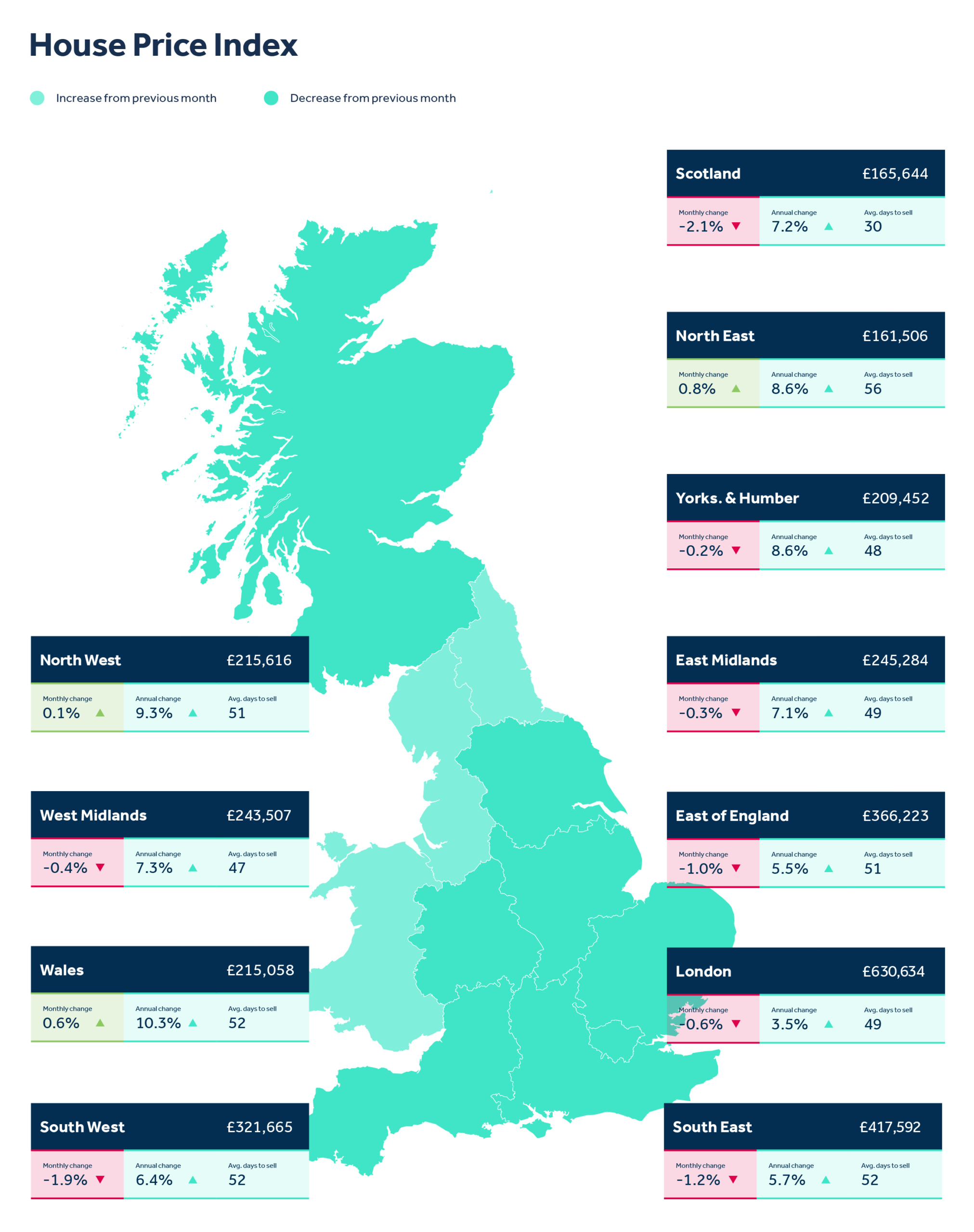
What are the headline figures?
- Average price of property coming to market dips by 0.5% (-£1,505) from last month
- The number of sellers coming to market last month was up 35% on the same time last year
- National sales agreed are up 50% on October last year, and we estimate there’s 650,000 sales going through the buying and selling process, 67% more than at the same time in 2019
- There’s been a 106% uplift in sales agreed and a drop of 23 days in time to secure a buyer in £400,000-£500,000 band
- Buyers who were temporarily uncertain in run-up to the new lockdown in England have jumped back into action, with the first six days of the second lockdown seeing demand up by 49% on this time last year, as the housing market remains open
What do the experts say?
Our resident property data expert Tim Bannister explained that sellers are much more likely to find a buyer if their first asking price is realistic, rather than setting the bar too high to begin with and having to reduce the asking price at a later date.
He said: “Given the ongoing mini-boom, prices might have been expected to rise again this month, but instead we have a slight dip which could be a result of some new sellers pricing more realistically to have a better chance of agreeing a sale in time to benefit from the stamp duty savings on their onward purchase.
“We know from a recent Rightmove study that sellers are twice as likely to sell if they agree a sale based on the first price at which their property goes on the market, something that’s even more important now as we move towards the end of March and the end of the stamp duty holiday.
“If your initial asking price is too high then you’re less likely to get an offer even after you’ve cut your price back to a more realistic level. Our revised prediction of a 7% annual increase in prices in 2020 looks to be on track, since the annual rate has jumped to 6.3% with a month to go.”
What are estate agents seeing?
Bruce King, Director of Cheffins in Saffron Walden, said: “Sellers are taking a realistic view on pricing in the current market. By competitively pricing their homes they’re looking to entice buyers and agree a deal ahead of the stamp duty deadline, whilst also being able to benefit from stamp duty savings on their onward purchase.
“Transaction levels have gone through the roof in comparison to the past couple of years due to the monumental backlog of people looking to move. Political uncertainty, Brexit and the first lockdown period caused many who were considering moving to sit on the fence, however the announcement of the stamp duty holiday was the trigger for many of these to bite the bullet and get on with moving house.
“This, coupled with the change in lifestyle which has been caused by the coronavirus outbreak, has created a pressure cooker in the market which has resulted in activity which couldn’t have been foreseen around a year ago. The market in the £400,000 – £500,000 bracket is certainly the most busy, mainly made up of second-steppers and upsizers.
“First-time buyers are continuing to struggle, as the level of deposit needed has increased and this, combined with a lack of job security for many, has meant that mortgage agreements have been harder to come by as banks change their lending criteria. Demand has remained strong in lockdown 2.0. Mid-November usually brings with it the pre-Christmas slowdown in the market; however, this doesn’t appear to be the case this year as buyers still look to get a sale over the line before the stamp duty deadline.”
Andy Shepherd, CEO of Dexters, added: “London remains a huge draw for investment and city living, and we currently have over 100,000 people registered looking for a new home or investment property, up 25% compared with this time last year.
“The recent reductions in stamp duty have coincided with a busy property market and they are motivational to buyers. However a stamp duty holiday isn’t the main reason for people buying property in the capital.
“Sellers and buyers will most likely share the extra tax burden when it returns next year and although the amounts are not insignificant, we don’t expect them to impact on the market greatly in 2021, arriving as they will in the spring which is the start of the busiest time of the year for moving home. Additionally the potential roll out of a vaccine in the new year could see a greater number of overseas buyers, increasing demand in prime central London especially.”
If you are considering selling or letting your property in Ashtead, Leatherhead, Fetcham, Epsom, Bookham or the surrounding areas, call V&H Homes on 01372 221 678

Newly released data from Halifax has revealed that during October, average house prices across the UK topped £250k for the first time ever following the strongest growth in over four years.
Halifax data shows that on a monthly basis, house prices in October saw a 0.3% rise against September and between August and October, saw a 4.0% rise against the preceding three months. Driven by the mini-boom, research shows that house prices in October were 7.5% higher than in the same month a year earlier – the strongest growth since June 2016.
Russell Galley, Managing Director, Halifax, comments: “The average UK house price now tops a quarter of a million pounds (£250,547) for the first time in history, as annual house price inflation rose to 7.5% in October, its highest rate since mid-2016. Underlying the pace of recent price growth in the market is the 5.3% gain over the past four months, the strongest since 2006. However, month-on-month price growth slowed considerably, down to just 0.3% compared to 1.5% in September.
“Overall we saw a broad continuation of recent trends with the market still predominantly being driven by home-mover demand for larger houses. Since March flat prices are up by 2.0% compared to a 6.0% increase for a typical detached property. In cash terms that equates to a £2,883 increase for flats compared to a £27,371 rise for detached houses.
“This level of price inflation is underpinned by unusually high levels of demand, with latest industry figures showing home-buyer mortgage approvals at their highest level since 2007, as transaction levels continue to be supercharged by pent-up demand as a result of the spring/summer lockdown, as well as the Chancellor’s waiver on stamp duty for properties up to £500,000.
“While Government support measures have undoubtedly helped to delay the expected downturn in the housing market, they will not continue indefinitely and, as we move through autumn and into winter, the macroeconomic landscape in the UK remains highly uncertain. Though the renewed lockdown is set to be less restrictive than earlier this year, it bears out that the country’s struggle with COVID-19 is far from over. With a number of clear headwinds facing the housing market, we expect to see greater downward pressure on house prices as we move into 2021.”
Anna Clare Harper, CEO of asset manager SPI Capital and author of Strategic Property Investing, says: “According to Halifax, house prices were 7.5% higher than in the same month a year earlier. On the face of it, this feels like positive news amidst much that is negative – economically, politically, and socially – at least for property owners. It’s not as simple as this, and this pace of growth is not forecast to continue at the same level.
“Right now, prices are being buoyed up by the temporary Stamp Duty reduction, the release of pent-up demand and supply, and the desire to improve surroundings following lockdown. For example, growth in detached properties was 6%, due to many families understandably seeking more space. Another important factor is that in times of uncertainty, there is a ‘flight to safety’: many people prefer to invest in tangible assets like property.
“The truth is, the housing market is not one market. If you’re thinking about buying a property in this fast-changing environment, one of the best things you can do is to detach from the emotional dimension, so that you are able to analyse whether you are getting a good price and ‘value for money’.”
If you are considering selling or letting your property in Ashtead, Leatherhead, Fetcham, Epsom, Bookham or the surrounding areas, call V&H Homes on 01372 221 678
“Amidst the chaos and uncertainty, the property market is a positive beacon and a sign that people are finding ways to get on with their lives.”
Lockdown part 2 will not include a second lockdown of the UK housing market.
Within hours of the announcement by the Prime Minister, Secretary of State for Housing Communities and Local Government; Robert Jenrick confirmed that renters and homeowners will be able to move; removal firms and estate agents can operate; construction sites can and should continue; and tradespeople will be able to enter homes.
RICS also confirmed that, where appropriate, professional surveying services can continue, in a safe and secure manner, and that all activities must be done in accordance with existing government guidelines. In short, it’s business as usual!
When the property market reopened in May after the first lockdown, RICS provided detailed guidance for surveyors carrying out property inspections. I was involved in helping to draft the guidance, which was based on practical first-hand knowledge of what would be required. The full details are available here: https://www.rics.org/…/covid-19-guide—rics-physical-inspe…, but the main points require surveyors to wear appropriate PPE, maintain distance from any occupiers of the property, aim for minimal amount of contact with surfaces and sanitize equipment. In the heightened atmosphere of a second lockdown, there will clearly be greater emphasis on surveyors exercising caution, but the detail of this guidance remains.
Today’s business as usual is, of course, very different to standard trading environments we have known in the past. The property market has been turbo-charged since the easing of the first lockdown and announcement of the stamp duty holiday and it has exhibited some very particular trends.
The second lockdown is likely to entrench those trends of people looking for houses with more space, both inside and outdoors, and will most probably encourage even more people to move out of large cities and suburban areas. I recently spoke to someone from a removal firm who said they are used to providing 160 quotes a month. At the moment they are averaging more than 300 quotes a month and most of these were for people leaving London and heading to the sea and countryside.
It will be interesting to see what stance the government takes regarding the end of the stamp duty holiday for properties valued up to £500,000, which is scheduled for the end of March. There are already delays in the system, leading to speculation that many current transactions may not complete in time to beat the deadline, and the property industry has called upon the government to take action to avoid a cliff edge. This second lockdown adds weight to those calls. It may well slow activity in the market, which could help to clear the backlog being experienced across the chain from mortgage lenders through to surveyors, conveyancers and local councils carrying out searches, but will also provide added considerations and potentially more delays.
It’s business as usual as it can be at the moment. People continue to be driven to move home, motivated by personal and lifestyle reasons and there is still no sign of this activity softening. Amidst the chaos and uncertainty, the property market is a positive beacon and a sign that people are finding ways to get on with their lives.
If you are considering selling or letting your property in Ashtead, Leatherhead, Fetcham, Epsom, Bookham or the surrounding areas, call V&H Homes on 01372 221 678
The housing market is to remain open during the second lockdown in England.
Uncertainty over whether estate and letting agencies will be classified as essential services under Thursday’s lockdown rules, has been clarified.
In a statement to the industry, the Government says: “Buying, selling and renting a home can continue, in a COVID-secure way, as it has in recent months. Estate and letting agents can operate, show homes and sales suites can remain open and property viewings, mortgage valuations and surveys can take place.”
Subject to approval, the regulations specifically state that activities relating to the sector are allowed to continue under exceptions to leaving home to undertake any of the following activities in connection with the purchase, sale, letting or rental of a residential property:
- visiting estate or letting agents, developer sales offices or show homes;
- viewing residential properties to look for a property to buy or to rent;
- preparing a residential property to move in;
moving house; - visiting a residential property to undertake any activities required for the rental or
- sale of that property.
V&H Homes have been operating under the Covid-19 Secure Guidelines since May and will continue to prioritise the saftey of our clients and staff whilst we remain fully operational.
We cover property sales and property lettings in Ashtead, Leatherhead, Fetcham, Epsom, Bookham and the surrounding areas.
If you are looking to sell, let, buy or rent a property, or if you are just looking for some advice, please call us on 01372 221 678.

Owning a leasehold property is extremely common in England and Wales, but it can be tricky to know exactly what it means.
Here, we’ve compiled a list of frequently asked questions on the subject so that you’re better equipped the next time you think about buying a leasehold.
I’ve found my dream home, but it’s a leasehold. What does that mean?
Leasehold is one of the most common ways of owning a flat/maisonette/apartment in England and Wales. The other option is freehold but, unlike freehold (where you own the property outright), leasehold only gives you exclusive ownership of the right to occupy the property for the length of the lease. This can be anything between 99 to 999 years when a lease is first created.
I’ve heard people mentioning ‘ground rent’, but will I have to pay it?
Unfortunately, there’s no way around this. Ground rent is what a leaseholder pays each year to their landlord. It can be a small amount (£10), or substantial (£200) per year. In some cases, the ground rent can increase considerably over short periods. Your solicitor should advise you if this is the case, but it’s a good idea to ask early on how much the ground rent is, whether it changes (and when) as well as the consequences of any increase.
Do ‘service charges’ apply to me if I buy a leasehold flat?
Again, you’ll need to set aside some cash for this. Service charges are your share of the cost of maintaining the building your flat/maisonette/apartment is in. It also covers the communal areas and the communal services. These charges are usually paid annually and in advance, but the amount will vary depending on the building, its age and condition. It’s important to ask your landlord about the cost of previous service charges and whether there are plans for large expenditure in the future, such as roof renewal or external painting.
I’m buying a flat in a large block on a development with communal heating and lifts, will this be expensive to maintain ?
It is difficult to know precisely what the cost of maintaining or renewing items like these will be. That is why it is always wise to establish early whether the property has a ‘reserve’ or ‘sinking’ fund. These terms are often used interchangeably, but the aim of such funds is that leaseholders contribute each year so that large expenditure for these works can be spread over a number of years, rather than a leaseholder facing a large service charge in the year the works have to be carried out.
I’m thinking of buying a leasehold flat, but how is the block maintained?
When you buy leasehold, you become a leaseholder, and, like any tenancy agreement, the lease sets out your rights and obligations. The landlord, usually a freeholder, will also have their rights and obligations set out in the lease.
Like any building, the block containing the flats will need internal and external maintenance. It may also have communal heating, or lifts that require maintenance. The freeholder is normally responsible for such maintenance, although the cost is passed on to leaseholders via the service charge. The freeholder will typically employ managing agents to manage the building on their behalf.
I understand that the building containing the flat I want to buy is managed by a professional agent, what could I do if I was unhappy about their handling of a complaint?
Building management can be complicated, so many freeholders will appoint an agent to do the day-to-day management tasks, like building insurance, organising regular and irregular repair and maintenance; and responding to enquiries from purchasers.
An agent managing a building containing flats should be registered with either the Property Ombudsman or the Property Redress Scheme. The law requires agents to join one of these redress providers in order that leaseholders dealing with property managers will be able to complain to an independent body about the service they have received.
I’m thinking of buying a leasehold flat in a retirement development, will I have to pay for any extras?
Potentially. There may be services and facilities, such as a warden (either live-in or visiting), and a 24-hour emergency call system. These may well be paid for by leaseholders through their service charges.
I have been told to look out for ‘event fees’ if I’m looking to buy a leasehold flat in a retirement development. What are these?
Event fees are common in retirement flat leases. They are payments that the leaseholder makes to the freeholder when the flat is sold on, or if it’s sub-let. The percentage is usually based on the sale price or the rent when sub-let.
In some cases, the fee is put into a fund for the continued running of the building or development to avoid large increases in service charges as time goes by. Such increases are worrying because pension income may not keep pace with them. In other instances, the payment is simply income to the freeholder and does not go towards any services. So, it’s important that at an early stage your solicitor asks whoever is managing the building(a) whether there are event fees (b) when they will arise and (c) what the payments will be based on.
How do I check on fire risks in a building where I would like to buy leasehold flat?
By reading the building’s fire risk assessment – your solicitor should ask for a copy from whoever is managing the building. All blocks of flats in England and Wales are required to have a, regular, fire safety risk assessment. It covers:
- how likely a fire is to start;
- what would happen if a fire started; and
- how to minimise the risk of fire starting or spreading
I would like to alter a leasehold flat after I buy it, but will I be able to?
Some leases ban alterations altogether, some allow it so long as you obtain consent, while others have no restrictions. Before buying you should check if you need the lessor’s consent ahead of making alterations. However, you may need to first approach the managing agent working on behalf of the lessor/landlord.
I hope to be able to sub-let a leasehold flat I’d like to buy, but will I be able to?
Some leases don’t allow any sub-letting, some require consent and others are silent (there are no restrictions on sub-letting) But because leases can vary, it’s important that you check with the lessor (your landlord, typically the freeholder), before buying, whether your flat has restrictions or conditions for sub-letting.
Can my leasehold expire?
Yes, like any tenancy, leasehold has a start and finish. Make sure you know how long is left before you buy, because as it gets shorter, it becomes more difficult to sell. Leases often start at 99 years or more, but they will get shorter as each year passes. Ideally, make sure the leasehold has over 80 years remaining. Lenders may insist on a certain length of lease, but each may have different requirements. Most set out their requirements in UK Finance’s Mortgage Lender’s Handbook. Your estate agent should be able to give you information on how long is left on the leasehold, and your conveyancer or solicitor should tell you.
You will have a right to extend the lease of a flat after two years of ownership, but you will have to pay the freeholder for this and the cost can be substantial, depending on the length left on the lease. If your lease expires, you have certain rights if you live in the property. But if you are to continue to live there you are likely to have to pay a market rent.
Here is a list of questions that you should ask your estate agent or solicitors when buying a leasehold flat:
- How many years remain on the lease?
- What is the current ground rent?
- Does the lease provide for the ground rent to increase?
- Can I see the last three years’ service charge accounts?
- Is there a sinking fund for the building and how much money is in the fund?
- Is any significant work expected to be carried out to the building in the future which will have a big impact on the service charges?
- Does the property have a managing agent; and, if so, are they registered with a redress provider?
- Can I alter the property?
- Can I rent out the property?
- Can I run a business from the property?
- Can I keep a pet at the property?
- Is there a residents’ association ?
If you are considering selling or letting your property in Ashtead, Leatherhead, Fetcham, Epsom, Bookham or the surrounding areas, call V&H Homes on 01372 221 678