
Want to know what your property is worth?
Want to know what your property is worth?

Need a hand selling your home this autumn? |
|
||||||
|
||||||
|

|







Last month, changes were made to how some aspects of Right to Rent checks are completed in England.
Since 2014, anyone letting a property in the UK has been obliged to complete a Right to Rent check every time they take on a new tenant. As part of the changes to Right to Rent checks, landlords in England are no longer allowed to accept physical biometric residence cards and permits, nor Frontier Worker permits. All holders of these cards and permits in England will have to verify their identity using an online service operated by the Home Office.
There are legal implications for anyone who does not follow the new laws. It is illegal for landlords to only check people that they think are not British citizens; the government states that potential tenants should not be discriminated against based on speculation about where they are from.
For now, this change is limited to tenancies in England. For the rest of the UK and Northern Ireland, the Home Office will require tenants to register with a certified identity service provider (IDSP), which will use identity document validation technology (IDVT) to share checks with agents and landlords.
If you are a tenant or landlord looking for answers, get in touch and we will help wherever we can.


With demand for homes still outstripping supply, sellers can be confident they will find a buyer quicker than ever before. *
On average, properties are spending just 33 days on the open market, compared to 2019 when the average time on the market stood at 67 days. As well as this, the huge decline in sale time means that 53% of property sales are now being agreed at a figure above the asking price, as buyers bid higher to secure their ideal home. *
The large number of buyers continues to create a competitive market, ideal for sellers. Over 125,000 prospective homeowners took to the market in April to take advantage of the great seller’s market. *
If you are looking for a quick sale of your property, start by booking a free property valuation here.

*Rightmove

Last year, Rightmove saw a 26% increase in web traffic, with over four million of us visiting their website on Boxing Day.
Your property could be marketed to a HUGE online audience over the festive period and the New Year.
Listing is a sure-fire way of capturing attention from serious buyers and tenants.
Did you know...
Online property searches double over the Christmas and New Year period.
On average, there's a 20% increase in people searching online for their next home.
9 pm was the citied as last year's prime property-surfing time.
Over 2.3 million people visit Rightmove on the 29th December.
Over 3.3. million people visit Rightmove on the first day of the New Year.

The next six months are expected to be a busy time for the property market
As restrictions are officially lifted and the stamp duty holiday draws to a close, we take a look at what will be influencing home purchases going forwards over the next few months.
What will happen to house prices after the stamp duty holiday?
As demand still remains above normal levels for the season, many people will be undeterred by the end of stamp duty savings next month.
Instead, they'll be pushed to buy based on their changing needs and living conditions, meaning house prices are expected to remain consistent.
Market update
Over the last year, average property prices in Surrey, have increased by 12%, with the average property now worth £613,048.*
*Rightmove Intel

Taking a step on the ladder is really exciting!
So, you shouldn’t be daunted by mortgages. We can help you find your perfect property and offer you expert mortgage advice.
What is a fixed-rate mortgage?
With a fixed-rate mortgage, the interest rate that you pay remains the same throughout the period of the contract – typically one to five years. Choosing a fixed-rate mortgage means that you will know exactly how much your mortgages will cost for a set period of time, and your repayments will remain the same, even if interest rates change.
What is a tracker mortgage?
The interest rate on a tracker mortgage is linked to the Bank of England base rate. This means that if the base rate changes, so will your mortgage rate. You can get lifetime or term trackers that are often very flexible and can be great if you don’t want to be tied into a mortgage.
What is a guarantor mortgage?
With a guarantor mortgage, your friends or family members can opt to be your mortgage guarantor. With this type of mortgage, if you miss any repayments, your guarantor could risk losing their savings or their home.
More than a quarter of UK homeowners and renters have claimed that their property priorities have changed since the COVID-19 outbreak.
Previously highly-sought after and high-value property features have dropped down the priority list for home buyers and tenants, as they now seek different factors when looking for a property that meets their needs and lifestyles.
Easy commutes to work, proximity to local shops and restaurants, and local public transport links are no longer as desirable as they once were.
Instead, we have noticed a significant increase in those searching for more space, whereby those searching are willing to compromise on location or local amenities in return for larger bedrooms and a 'work from home' zone.
Having access to a private garden or nearby green space has also become one of the top preferences for homebuyers and renters, especially in light of reduced travel options this summer.
If you need more space, call V&H Homes on 01372 221 678 to see how we can help.
This article was extracted from Rightmove for informational purposes
The government has announced that the temporary stamp duty holiday in England and Northern Ireland has been extended until the end of June.
The news will hopefully come as a relief to those buyers and sellers who have been desperately trying to get their sale completed in time to meet the previous deadline of 31st March.
What is the temporary stamp duty holiday?
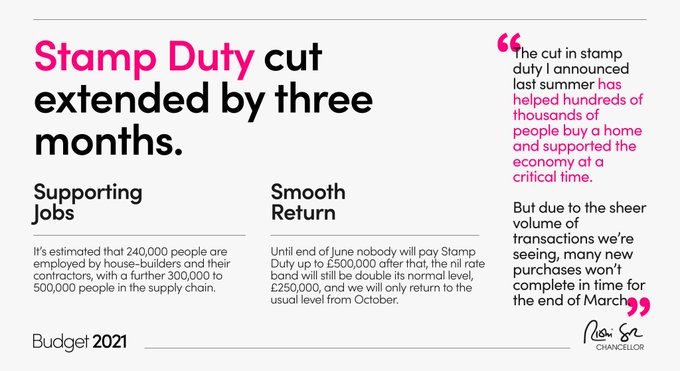
The temporary stamp duty holiday, first announced by the government on 8th July last year, means that if you are buying a home up to the value of £500,000 you will not pay any stamp duty.
The extension means you now have until 30th June to complete on the purchase to make the stamp duty saving.
Then, to smooth the transition back to normal, the nil rate band will be £250,000, double its standard level, until the end of September.
It will return to the usual threshold of £125,000 on 1st October.
There hasn’t been any further update from Scotland on any extension to the Land & Buildings Transaction Tax (LBTT) holiday, which is currently due to end on 31st March 2021.
In Wales, temporary Land Transaction Tax reductions are also set to end on 31st March, but we’ll let you know if this changes.
Are there delays in the home-moving process right now?
When the announcement was first made in July we recorded our busiest ever day on Rightmove, as people rushed to see if they could move home and make use of the savings, leading to a huge increase in the usual number of sales that would be going through the legal process.
We estimate that there are currently 628,000 sales going through, and this massive number, coupled with the challenges of conveyancers, solicitors and councils working from home, has led to delays in the home-buying process.
Our latest data shows that it is taking an average of 65 days from the time a seller has a property listed by an agent on Rightmove until they get an offer accepted, and a further 126 days to get through to legal completion, which is almost seven months.
But remember these are averages, and other factors such as if you are a cash buyer or if council searches in your area take longer will affected how long it takes.
What do the experts say?
Our resident property data expert Tim Bannister explained that the stamp duty holiday extension should give tens of thousands of home-movers the chance to complete before the new deadline.
He said: “This three-month extension will come as a huge relief for those people who have been going through the sales process since last year and were always expecting to make use of the stamp duty savings.
“Our recent data shows one in five sales that were agreed in the same month the stamp duty holiday was first announced in July last year still haven’t completed, so this additional time will make a big difference to help those stuck in the logjam complete their purchase in time before the new end of June deadline.
“Buyers who have recently agreed a sale now have a race on their hands to see if they can also make use of the stamp duty savings, but many with purchases over £250,000 will find that time is too tight to complete before the end of June and so shouldn’t be factoring this into their purchase.
“It’s worth remembering that the average savings vary massively around England, and first-time buyers will still be exempt if they’re buying for £300,000 or less. There are also many other reasons people are choosing to move, evidenced by the strong buyer demand Rightmove has already seen in the first two months of the year.”

The following information is extracted from Rightmove
A mortgage guarantee scheme aimed at helping first-time buyers and existing homeowners is set to be unveiled by the government in this week’s Spring Budget announcement.
Chancellor Rishi Sunak is expected to reveal the specifics of the scheme on Wednesday (3rd March). In the meantime, we can share what we know so far.
What do we know about the mortgage guarantee scheme?
Under the new scheme, which is expected to launch in April, we anticipate that buyers will be able to purchase homes worth up to £600,000 with a deposit of just 5%.
And this means that the majority of buyers should be eligible for the scheme, as our data analysts have found that 86% of properties currently listed for sale on our site have an asking price of £600,000 or less.
However, please note that with an average asking price of £621,886, many properties across Greater London will be priced above the scheme’s proposed threshold of £600,000 (see below).
What impact could the mortgage guarantee scheme have regionally?
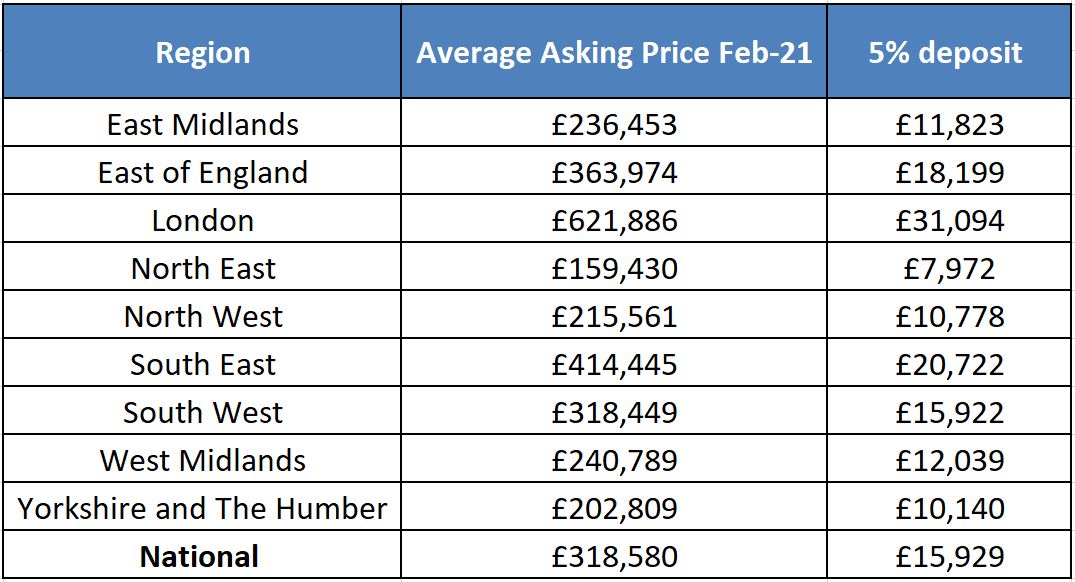
What are some of the key statistics?
- The national average asking price for all properties is currently £318,580, which is 3.0% higher than February 2020
- The national average asking price of a first-time buyer property is £200,692, which is 3.6% higher than February 2020
- Since the 2013 Help to Buy mortgage guarantee scheme was first launched, national asking prices have increased by 29% from £246,748 in October 2013 to £318,580 in February 2021
- Since the 2013 Help to Buy mortgage guarantee scheme was first launched, national asking prices for first-time buyer properties have increased by 36% from £147,464 in October 2013 to £200,692 in February 2021

The rent or buy debate is a pretty controversial topic with no simple answer, but we want to put paid to the ever-present myth that buying is always better than renting.
But renting doesn’t mean you are throwing away money in the same way that buying a home isn’t always the right decision at certain times in your life. So we’ve come up with a list of 12 reasons why renting might just be the better option for you.

1.No maintenance costs or repair bills
When renting a property, your landlord is usually responsible for all maintenance and repair costs, ensuring you don’t have the financial responsibility to get these things fixed.

2. No large down-payment
Renters have the better financial deal upon signing as a house with a mortgage requires a sizable down payment compared to the usual deposit for renting a property.

3. There’s a fixed rent amount
Rent amounts are certain for the span of the lease agreement – so long as it’s a fixed-term contract – making it easier to budget your money so you know exactly how much you’re required to pay.

4. You can keep things flexible!
When you buy a house you are tied down to living in that location for at least a few years usually, whereas if you’re renting a property you have the flexibility to move around if something changes in your life or outlook.

5. You have the options for housemates
Housemates are many things – from being someone to split the bills with to potentially becoming some of the best friendships you may ever have.

6. Invest money on your own terms
Choosing not to buy a home – at least for the moment – opens up other possibilities for saving and investing so you can choose exactly where your hard-earned money is going.

7. Generally lower utility costs
Rental properties typically have a more compact floor plan, therefore renters can often expect to face lower utility costs – another money saver.

8. Enjoy being mortgage-free
By renting you can put away as much (or more) savings as a homeowner, but without the debt that comes along with owning a property.

9. Urban living at a cheaper price
Depending on where you want to live, trendy areas, such as major cities, and beach communities, are typically more renter friendly.

10. Decreasing property value
Property values go up and down over the years depending on the area you live, and, while this may affect homeowners in a big way, it affects renters substantially less so, if at all.

11. Excuse yourself from costly updates
As a renter, there is freedom in knowing you couldn’t remodel your home even if you wanted to, so this a way of saving money.

12. Insurance is cheaper
Renter’s insurance is significantly cheaper than the insurance home owners have to pay.

So there you have it. It’s likely you already have your own opinion about whether renting or buying is right for you now – or in the future – but hopefully this article has given you a few reasons to show that renting can be seriously advantageous for many of us.
If you are considering selling or letting your property in Ashtead, Leatherhead, Fetcham, Epsom, Bookham or the surrounding areas, call V&H Homes on 01372 221 678

Under the current lockdown rules, home moves can still take place providing everyone follows the government’s safety guidance.
This means that you you’re free to contact estate agents, view homes in person, get your home valued, and do just about everything that home-moving involves, as long as you stick to the government’s latest advice.
If you’re unsure about what all these guidelines are, we’ve summarised them for you below.
But before we get into the details, the government maintains that the three most important rules continue to be:
- Wash your hands – with soap, regularly, and for at least 20 seconds.
- Cover your face – especially when in an enclosed space with people you don’t usually meet with, and where socially distancing is difficult.
- Maintain social distancing – stay two meters apart as much as possible.
Also remember that if you or anyone in your household is experiencing any flu symptoms or tested positive for coronavirus, you must pause your plans to move until you’re better. You shouldn’t view properties in person or allow people to come view yours until your period of self-isolation is over.
Viewings
Try to do a virtual viewing first, if it’s an option. It’ll reduce the number of viewings agents do, which also minimises the spread of germs.
It could also save you time, because you’ll have a better idea of whether a house is worth seeing or not.
When viewing a property in person, this should only be done by appointment. Make sure you wear a face mask, avoid touching surfaces, and wash your hands or use sanitiser before and after.
There shouldn’t be more than two households within the property at any one time, and viewings should only be arranged by appointment, so ‘open houses’ shouldn’t be happening at the moment.
If you’re selling your home and are having interested buyers come around to have a look, open all the inside doors beforehand so they don’t have to touch the door handles. You may also want to have some hand sanitiser available to them in case they forget theirs.
It’s recommended that you’re not in the property during the viewing, and that you disinfect all surfaces after.
Offers through to completion
You’re free to make or accept an offer or reserve a property as normal.
Bear in mind that in some areas the conveyancing process will be slower than usual, as some solicitors and agents may be operating at limited capacity, or are very busy working through deals that have stacked up over the last few months.
If you are about to enter into a legally binding contract, you should discuss the possible implications of one of the parties being affected by having to self-isolate or quarantine. Ask your legal representative if they can include provisions to manage these risks in the contracts.
If someone in your household – or the other party’s – began to show any flu symptoms just as you’re about to complete, you’ll probably need to postpone things by a few weeks.
The government says we should all remain flexible in this sort of scenario, so it would be ideal if your contracts can reflect that.
Moving
Removal firms are able to carry out work, as long as all the usual procedures that ensure everyone’s safety are in place.
Try to do most of your packing yourself, if possible. And if you can, give your belongings a quick spray or wipe-down with a disinfectant before they’re handled by someone else.
When the removals’ team is around, do your best to maintain distance and wash your hands regularly.
If you are considering selling or letting your property in Ashtead, Leatherhead, Fetcham, Epsom, Bookham or the surrounding areas, call V&H Homes on 01372 221 678