
Want to know what your property is worth?
Want to know what your property is worth?
The following information is taken from Rightmove...
"The property market has experienced a mini boom in 2020, and the big question many of you want answered is: will prices continue to rise in 2021?
Whilst we don’t have a crystal ball, we do have the biggest home-hunting audience in the UK, as well as unique insight into future demand for property.
So armed with all that data, we’ve produced a forecast of what we think will happen to property prices in 2021.
Our main prediction is that the recent surge in average asking prices will continue into next year, as the nation’s housing needs are likely to outweigh any economic uncertainty.
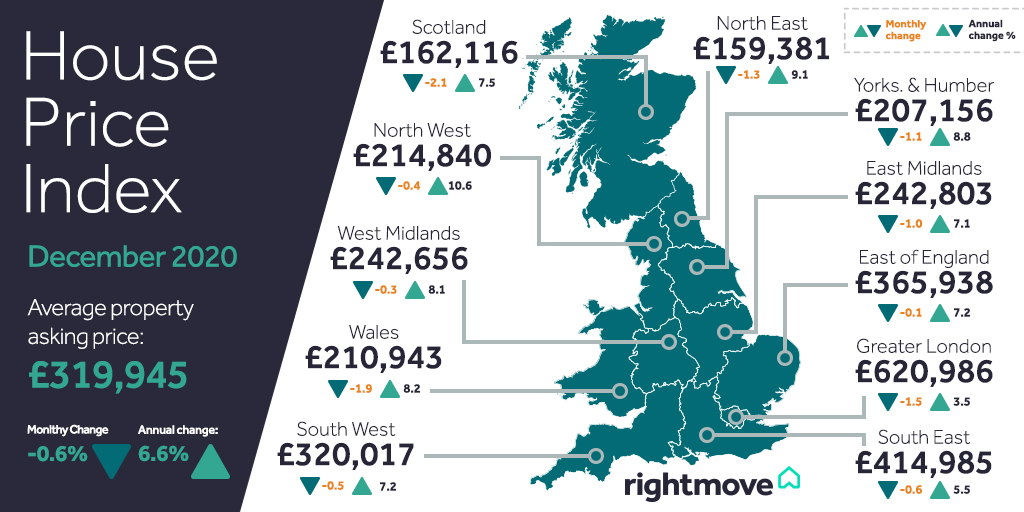
Specifically, we forecast a robust 4% national average house price growth in 2021. However, we think that the price rises will be at a slower pace than this year, which finished 6.6% up on 2019.
What can we expect from the property market in 2021?
It will be a busy start to 2021. The New Year is typically a time for resolutions for the year ahead, and many will see it as an opportunity to draw a line under 2020, which may well include a fresh start in a new home for those who have not already acted.
Many of you have already done so this year, and many more are continuing to do so despite the seasonally quieter run-up to the Christmas period and the declining chance of completing a purchase before the stamp duty deadline in March.
Despite the clock ticking, around 130,000 sales were agreed over the last month, up by a remarkable 44% on the same period in 2019.
However, there remains a processing logjam and some completions are already projected to be delayed until April next year, especially where there are search delays, legal issues or complex mortgage applications.
What will happen when the stamp duty holiday ends?
It will be a slower second quarter once the stamp duty holiday is over, though even with the average price in Britain up by 6.6% this year, cheap mortgage rates that are available for some leave scope for further modest price growth – despite the loss of the tax saving.
What do the experts say?
Rightmove's resident property data expert Tim Bannister explained that it may be quieter in the market in the spring.
He said: “2021 has a lot of variables, and so is not an easy one to call, but with Rightmove’s unique leading indicators of buyer and seller behaviour we are confident that the housing market will continue to outperform general expectations next year as it did this.
“Our 2021 forecast of a 4% price rise is more conservative than the unsustainable 6.6% national average seen this year. There’s likely to be a lull in quarter two unless the stamp duty holiday is extended, but for many buyers its removal will not be make or break, though may lead them to reduce their offers to a degree to compensate for the higher tax, and indeed many sellers may be prepared to help to mitigate their buyer’s financial loss.
“First-time buyers will remain largely exempt, so in most cases will be no worse off. The maximum savings of £2,450 in Wales or £2,100 in Scotland are considerably less decisive than the £15,000 available in England for a house costing £500,000 or more, which does however only apply to a small part of the market.”
If you are considering selling or letting your property in Ashtead, Leatherhead, Fetcham, Epsom, Bookham or the surrounding areas, call V&H Homes on 01372 221 678

Traditionally, spring and autumn are the most popular times to sell your house. But this year has been anything but ordinary and with the stamp duty deadline looming, many sellers have put their house on the market already.
If you are selling your home over the coming winter months, here are some tips to help make sure your property stands out.
- Make your home a cosy refuge from the cold. Put the heating on ahead of viewings and, if you have one, light the fire. Check all your light bulbs, make sure the lights are on throughout the house and consider placing lamps to brighten up any dark corners. For viewings in the late afternoons and evenings, ensure outside lights are on before anyone arrives.
- As ever, promote your home’s best features. With strong demand for home working spaces, showcase how your property fits the bill – whether it’s a separate office or a dedicated desk for home schooling in the playroom. By all means tidy up but don’t feel the need to tidy work away, as it will show off how the space can be used.
- Don’t forget the garden. Outside space is at the top of many buyers’ wish lists so ensure yours is presented in its best light, despite the gloomy winter weather. Make sure it looks cared for by raking up leaves, clearing guttering, mowing the lawn, trimming shrubs, clearing moss from paths and tidying plant pots, removing any weeds. Don’t forget to cut back plants growing around windows so they’re not blocking the light. Put away garden furniture unless it’s a dry, sunny day when you could get it out for viewings.
- As is the case with selling at any other time of the year, make sure your home is clean, decluttered and tidy, and finish off any odd jobs around the house that need doing. Tidy up paintwork and fix damp patches, superficial cracks or stains on ceilings or walls left by previous leaks. This sort of upkeep is typically inexpensive to sort out but can be off-putting on a viewing.
- First impressions count. The front door can get dusty and dirty at this time of year, especially if you live in a town. Keep it washed down and polish any brass door furniture. A collection of pots full of winter flowers by the front door is a welcoming touch and will brighten things up.
If you are considering selling or letting your property in Ashtead, Leatherhead, Fetcham, Epsom, Bookham or the surrounding areas, call V&H Homes on 01372 221 678
The asking prices of property coming on to Rightmove increased in our last two monthly reports, but this month they’ve seen a dip of around £1,500.
Is this something for sellers to worry about? We don’t think so, as there are a few reasons for the slight drop.
Firstly, the stamp duty holiday on homes up to £500,000 is due to end on 31st March, and so sellers putting their property up for sale now are perhaps pricing a bit more realistically so that they have a better chance of a quick sale.
Secondly, asking prices usually drop at this time of year, and this month’s drop is actually lower than we’ve seen over the past few years.
The good news if you’re a new seller is that buyer demand is staying strong despite the second national lockdown in England. We saw an initial, temporary dip after the new restrictions were first announced, but demand was still up by 28% on the same days last year during the three days between the announcement and the lockdown.
The first six days of lockdown saw demand jump back up to being 49% higher than this time last year, as the market is still open and agents can still operate.
The temporary stamp duty savings that can be made vary a lot depending on the price of the property you’re buying.
We had a look andfound that demand and activity compared with October last year are strongest in the price bands and regions where buyers are set to make the biggest stamp duty savings.
For example, the number of sales being agreed for properties priced between £100,000 and £200,000 is up by only 16% on this time last year.
Whereas the number of sales being agreed in the £400,000 to £500,000 price band has more than doubled (+106%).
In terms of how quickly homes are finding a buyer, the national average is now at a record low of 49 days.
However, homes priced between £400,000 and £500,000 have seen a big drop of 23 days to secure a buyer, compared to the £100,000 to £200,000 band seeing a drop of just eight days.
Regionally, the south is performing best relative to last year for the number of sales being agreed, up by 72% in the East of England, and up by 69% in the South East.
But we now estimate that there are around 650,000 sales going through, which is up by a massive 67% on the same time in 2019, and we know there are delays in the process so communication is key for people trying to get their sale over the line.
What are the headline figures?
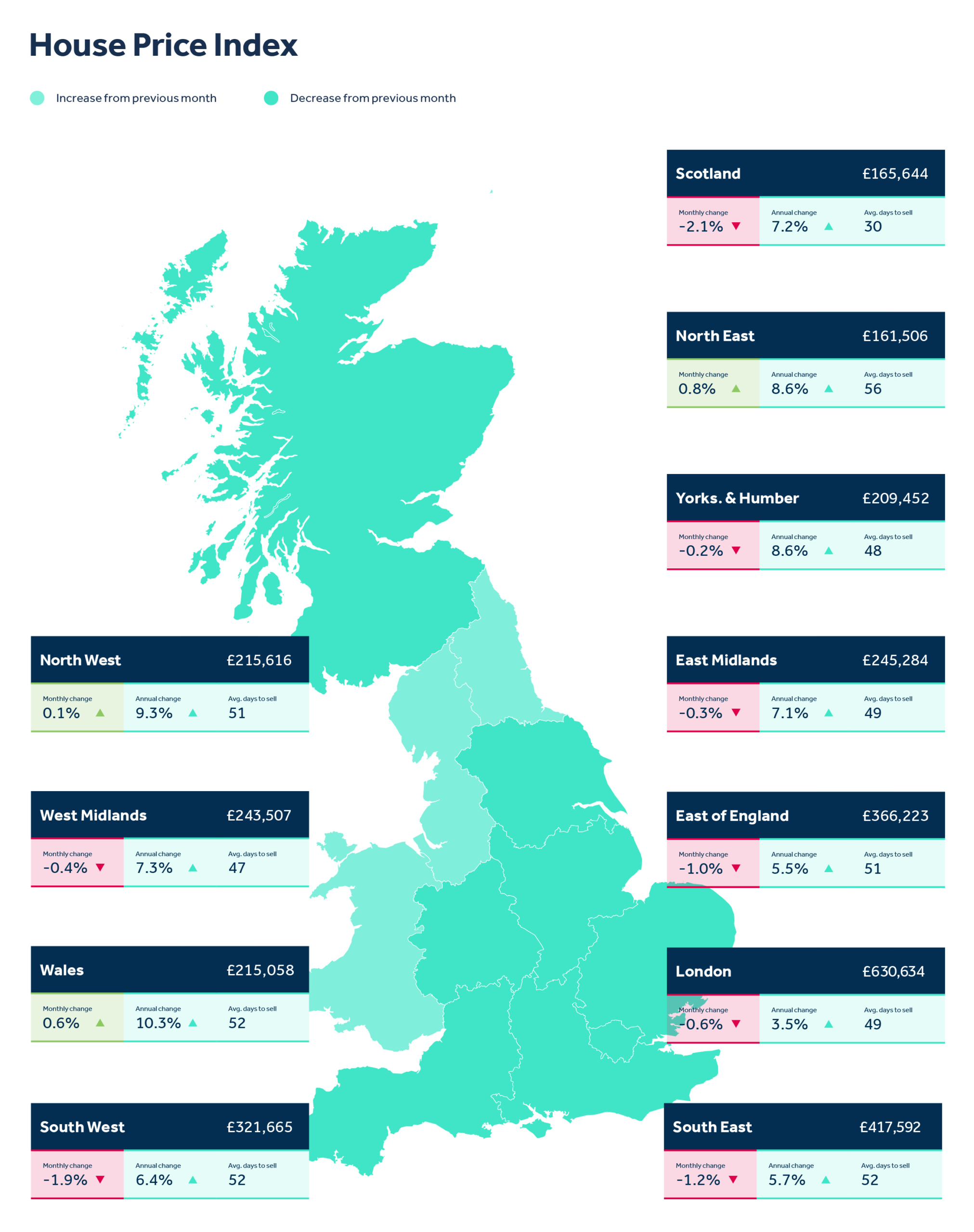
- Average price of property coming to market dips by 0.5% (-£1,505) from last month
- The number of sellers coming to market last month was up 35% on the same time last year
- National sales agreed are up 50% on October last year, and we estimate there’s 650,000 sales going through the buying and selling process, 67% more than at the same time in 2019
- There’s been a 106% uplift in sales agreed and a drop of 23 days in time to secure a buyer in £400,000-£500,000 band
- Buyers who were temporarily uncertain in run-up to the new lockdown in England have jumped back into action, with the first six days of the second lockdown seeing demand up by 49% on this time last year, as the housing market remains open
What do the experts say?
Our resident property data expert Tim Bannister explained that sellers are much more likely to find a buyer if their first asking price is realistic, rather than setting the bar too high to begin with and having to reduce the asking price at a later date.
He said: “Given the ongoing mini-boom, prices might have been expected to rise again this month, but instead we have a slight dip which could be a result of some new sellers pricing more realistically to have a better chance of agreeing a sale in time to benefit from the stamp duty savings on their onward purchase.
“We know from a recent Rightmove study that sellers are twice as likely to sell if they agree a sale based on the first price at which their property goes on the market, something that’s even more important now as we move towards the end of March and the end of the stamp duty holiday.
“If your initial asking price is too high then you’re less likely to get an offer even after you’ve cut your price back to a more realistic level. Our revised prediction of a 7% annual increase in prices in 2020 looks to be on track, since the annual rate has jumped to 6.3% with a month to go.”
What are estate agents seeing?
Bruce King, Director of Cheffins in Saffron Walden, said: “Sellers are taking a realistic view on pricing in the current market. By competitively pricing their homes they’re looking to entice buyers and agree a deal ahead of the stamp duty deadline, whilst also being able to benefit from stamp duty savings on their onward purchase.
“Transaction levels have gone through the roof in comparison to the past couple of years due to the monumental backlog of people looking to move. Political uncertainty, Brexit and the first lockdown period caused many who were considering moving to sit on the fence, however the announcement of the stamp duty holiday was the trigger for many of these to bite the bullet and get on with moving house.
“This, coupled with the change in lifestyle which has been caused by the coronavirus outbreak, has created a pressure cooker in the market which has resulted in activity which couldn’t have been foreseen around a year ago. The market in the £400,000 – £500,000 bracket is certainly the most busy, mainly made up of second-steppers and upsizers.
“First-time buyers are continuing to struggle, as the level of deposit needed has increased and this, combined with a lack of job security for many, has meant that mortgage agreements have been harder to come by as banks change their lending criteria. Demand has remained strong in lockdown 2.0. Mid-November usually brings with it the pre-Christmas slowdown in the market; however, this doesn’t appear to be the case this year as buyers still look to get a sale over the line before the stamp duty deadline.”
Andy Shepherd, CEO of Dexters, added: “London remains a huge draw for investment and city living, and we currently have over 100,000 people registered looking for a new home or investment property, up 25% compared with this time last year.
“The recent reductions in stamp duty have coincided with a busy property market and they are motivational to buyers. However a stamp duty holiday isn’t the main reason for people buying property in the capital.
“Sellers and buyers will most likely share the extra tax burden when it returns next year and although the amounts are not insignificant, we don’t expect them to impact on the market greatly in 2021, arriving as they will in the spring which is the start of the busiest time of the year for moving home. Additionally the potential roll out of a vaccine in the new year could see a greater number of overseas buyers, increasing demand in prime central London especially.”
If you are considering selling or letting your property in Ashtead, Leatherhead, Fetcham, Epsom, Bookham or the surrounding areas, call V&H Homes on 01372 221 678
“Amidst the chaos and uncertainty, the property market is a positive beacon and a sign that people are finding ways to get on with their lives.”
Lockdown part 2 will not include a second lockdown of the UK housing market.
Within hours of the announcement by the Prime Minister, Secretary of State for Housing Communities and Local Government; Robert Jenrick confirmed that renters and homeowners will be able to move; removal firms and estate agents can operate; construction sites can and should continue; and tradespeople will be able to enter homes.
RICS also confirmed that, where appropriate, professional surveying services can continue, in a safe and secure manner, and that all activities must be done in accordance with existing government guidelines. In short, it’s business as usual!
When the property market reopened in May after the first lockdown, RICS provided detailed guidance for surveyors carrying out property inspections. I was involved in helping to draft the guidance, which was based on practical first-hand knowledge of what would be required. The full details are available here: https://www.rics.org/…/covid-19-guide—rics-physical-inspe…, but the main points require surveyors to wear appropriate PPE, maintain distance from any occupiers of the property, aim for minimal amount of contact with surfaces and sanitize equipment. In the heightened atmosphere of a second lockdown, there will clearly be greater emphasis on surveyors exercising caution, but the detail of this guidance remains.
Today’s business as usual is, of course, very different to standard trading environments we have known in the past. The property market has been turbo-charged since the easing of the first lockdown and announcement of the stamp duty holiday and it has exhibited some very particular trends.
The second lockdown is likely to entrench those trends of people looking for houses with more space, both inside and outdoors, and will most probably encourage even more people to move out of large cities and suburban areas. I recently spoke to someone from a removal firm who said they are used to providing 160 quotes a month. At the moment they are averaging more than 300 quotes a month and most of these were for people leaving London and heading to the sea and countryside.
It will be interesting to see what stance the government takes regarding the end of the stamp duty holiday for properties valued up to £500,000, which is scheduled for the end of March. There are already delays in the system, leading to speculation that many current transactions may not complete in time to beat the deadline, and the property industry has called upon the government to take action to avoid a cliff edge. This second lockdown adds weight to those calls. It may well slow activity in the market, which could help to clear the backlog being experienced across the chain from mortgage lenders through to surveyors, conveyancers and local councils carrying out searches, but will also provide added considerations and potentially more delays.
It’s business as usual as it can be at the moment. People continue to be driven to move home, motivated by personal and lifestyle reasons and there is still no sign of this activity softening. Amidst the chaos and uncertainty, the property market is a positive beacon and a sign that people are finding ways to get on with their lives.
If you are considering selling or letting your property in Ashtead, Leatherhead, Fetcham, Epsom, Bookham or the surrounding areas, call V&H Homes on 01372 221 678
With many homeowners rushing to sell their properties and others looking to move thanks to the Stamp Duty holiday, homeowners have revealed the features they’re looking for, and the one’s they’re keen to avoid. According to new research from Hammonds Furniture, certain features could knock an average of £49,471 off your home.
Noisy neighbours, pet smells, pebble dash, being near a pub and the notorious Japanese knotweed are some of the most undesirable features of a house that would convince homeowners to ask for a discount or put them off a purchase altogether.
However, the two things most likely to put a potential homebuyer off a house were mould or damp on the walls (62%) and signs of a pest infestation (57%). Michael Patterson, Managing Director of WeBuyAnyHouse, claims these issues can knock a huge 20% off a property’s value, or £49,471 off the average house price of £247,355.
He said: “Mild cases of mould may not affect value too dramatically if all is needed is a dehumidifier and some mould-resistant paint, but very severe cases can reduce a property’s value up to 20%. Pests can also cause extensive damage, especially rats that are prone to chewing through electrics and wooden beams, which you would need to repair. Depending on the damage done, you could be looking at between 5-20% of a decrease in value”. However, while it’s common to be put off by signs of disrepair and neglect that may cost a significant amount of money to fix, surprisingly, a large number of homebuyers also claimed to be put off by features that can be quickly rectified.
A third of people (33%) would be put off a house if it had a messy garden, which could knock off up to 20% of a properties price, according to Michael. A quarter (24%) of people would look elsewhere if the house had ugly wallpaper, and two in ten (19%) people would be put off by holes in the walls from hanging pictures or paintings. A huge 37% of people would find pet smells off-putting, and 28% would reconsider a purchase if a house had a weak shower.
Many features that are out of a property owners’ control have also been proven to be detrimental to the price of a property. Four in 10 (39%) people would reconsider a purchase if a house if it had a “messy looking” neighbouring house (39%), almost half would if they could hear noisy neighbours (48%) and a surprising three in 10 people would dislike the thought of a pub nearby (32%). Perhaps less surprising, 14% would be put off buying a house if the road had a rude street name.
Other house buyers also claimed that they would be put off by features that others might find attractive; one in 10 people (10%) wouldn’t choose a property if it had a swimming pool or hot tub, and 13% would dislike laminate flooring.
When it comes to features that house buyers would pay more for, a garden tops the list with almost half of all homebuyers (45%) claiming that they would pay more for outside space. This is closely followed by a garage (37%) a conservatory (31%) and a loft conversion (27%).
Only 15% of people would pay more to be close to public transport, just 13% would pay more for a log burner and only 8% of people would be swayed by smart meters in the home.
According to Michael: “A nice sized garden can add up to 25% more on a house price, especially if it is well maintained with a seating area for the summer. A carriage driveway can add up to 15%, and an attractive conservatory can add up to 10% to a house price. If a loft conversion can be used as an extra bedroom, it can add 20% to a property price.”
Holly Herbert, Head of Content at WeBuyAnyHouse, offers her advice:
“In general, to get a house in a good position to sell I would say decoration is key – freshly painted walls make a big difference, even if it’s the same colour as before, as it will make the place brighter and remove any scuffs and marks. Gathering all information about the house for viewers is also important; general running costs, council tax band, local transport links. Getting it all in one place so you have it to hand with no hesitation is something buyers appreciate. And don’t forget to take the best possible advertising photos.”
Kirsty Oakes, Head of Product and Marketing at Hammonds Furniture, said:
“We all have something in mind when we begin a search for our next home, but there are certain features that for many people could be an absolute dealbreaker. However, some of these features are surprisingly quick and simple to amend if you are looking to sell your house.
“If you’re selling, you can make your house look much more appealing by making some small changes, such as filling in holes in the wall or switching to a neutral colour pallet. A deep clean can make a huge difference to how your property is perceived, and well as clearing away extra clutter (even if you just store it in your car). Don’t be afraid to ask your neighbours to clean their garden as well!”
If you are considering selling or letting your property in Ashtead, Leatherhead, Fetcham, Epsom, Bookham or the surrounding areas, call V&H Homes on 01372 221 678
According to tax specialist, Imogen Lea, financial penalties due to ‘seismic’ changes to CGT payment rules could heavily impact people selling buy-to-let properties.
From April 6th, anyone who disposes of a residential property giving rise to a capital gain on which CGT is payable, will be required to make a digital return to HMRC and to pay an estimate of the CGT due within 30 days from the sale completing.
People will also no longer be able to benefit from a possibly substantial sum of money remaining in their hands for up to 22 months after residential property disposal.
Imogen, a consultant in Clarke Willmott’s Taunton private capital team, says: “This is a very big change and could easily catch people out. Interest on the unpaid tax and other financial penalties will be due if the rules are not followed. The risk of such a tight turnaround is people being unaware of the changes and failing to comply. They need to be aware of the vastly reduced time limits and to be ready to make the return and estimate the CGT due.
CGT computations are not always straightforward, which could mean that if people are not prepared, they might not be able to collate the information necessary to make the CGT calculation in time.”
The changes will potentially affect owners of holiday homes, buy-to-let properties, main residences which have been let out at some point, owners of homes with grounds in excess of half a hectare, and owners of houses which have been partly used for business purposes.
Imogen says the changes will not generally apply on the sale of a person’s main residence, but will be relevant on the sale of second homes, and where the main residence exemption does not apply for any reason.
“Gains are not always straightforward to calculate – if an owner has made improvements to the property the cost of these will be deductible from the capital gain, but if there have been numerous improvements over many years it may be challenging for the client to find all the supporting documentation.”
Imogen urges property owners to make an early start of compiling the required information and to start thinking about the CGT position as soon as the property goes on the market.
CGT is calculated by treating the gain as the highest amount of the owner’s income during the tax year in question, and therefore clients will need to estimate their income during the tax year of disposal as this will impact on the CGT rate applicable to the gain.
Personal representatives and trustees, as well as individuals, will be required to comply with the new rules. Meanwhile, gifts of properties also give rise to a disposal for CGT purposes triggering the new requirements.
John Bunker, chair of Chartered Institute of Taxation’s private client UK committee, has branded the new reduced deadline as “a seismic change”.
If you are interested in buying selling or letting a property in Leatherhead, Fetcham, Ashtead, Bookham, Epsom or surrounding areas then please call the office on 01372 221 678 to speak to a member of the team.

Visits to Rightmove surpassed 150 Million for the first time ever on Rightmove in January, making it the busiest ever month ever recorded as home-hunters looked to take advantage of a more vertain political outlook.
There were over 152 million visits to Rightmove in January, a 7% increase on January 2019. The previous record for the busiest month was last set back in May 2019.
The top five busiest days ever on Rightmove were all between 21st and 29th January, with Wednesday 29th topping the list. There were over 5.7 million visits on that day, up 9% on the previous record set back on 24th April 2019.
Time spent by home hunters on the site was up 4%, with people spending a total of 1.17 billion minutes.
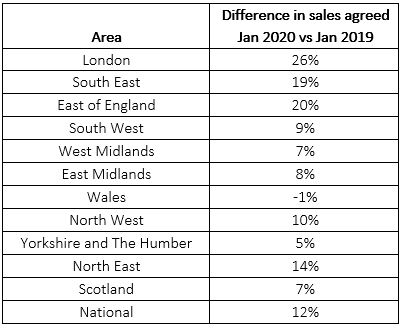
The number of sales being agreed by agents was up 12% compared to the same month in 2019, the biggest year-on-year in any month since July 2017. London saw the biggest uplift, up 26% year-on-year, followed by the East of England, up 20%.
Rightmove's property expert Miles Shipside said: " Home-movers have sprung into action in 2020, with a large number of agents telling us that sales and valuations have picked up significantly in their local areas. There's still an imbalance, with demand growing at a faster rate than new supply and no clear sign yet of any uplift in new listings compared on this time last year, but we could see a new wave of sellings in the coming weeks. The annual jump in sales agreed numbers is the highest we've seen in any month since summer 2016 because of the short-term dip in activity immediately after the Brexit vote. The stage certainly looks set for an active spring if those sellers considering putting their homes up for sale end up doing so, but to catch this wave of buyer momentum sellers should take care not to over-price their homes. It's still a price sensitive market and there's a limit to what buyers can borrow even though mortgage interest rates are temptingly low."
If you are looking to sell/let or buy a property in Ashtead,Leatherhead,Fetcham,Bookham or surrounding areas then please do give the office a call on 01372 221 678.

Many people these days are deciding to improve rather than move. Spiralling costs involved with relocating, low stock levels and economic uncertainty are all playing their part.
But what exactly can you do without planning permission, and is it safe to do it yourself?
Trying to figure out which projects you can do without planning permission can be a bit of a minefield, but don’t panic. As a rule of thumb, most structural changes are subject to building regulations, but some ‘bigger’ renovation projects can be done without planning permission if you adhere to the set size regulations.
Whether you’re building a new structure or making changes to an existing one, you’ll most likely need to submit an architectural drawing of the proposed project and get approval from the local authorities. To clear up the confusion, Comparethemarket.com have teamed up with a range of experts to create a tool that helps you work out which projects require planning permission and what to leave to the professionals.
To be on the safe side, leave any hard wiring and installations to a certified professional. However, if you’re plugging into a socket or wiring into a spur, this can normally be done by any competent amateur. For all other electrical work, you should get it carried out by a trader approved through an appropriate scheme, such as NICEIC.
Chris King, Head of Home at Comparethemarket.com, says: “Anything involving gas is generally best left to certified engineers due to the significant damage which could be caused if you get it wrong.”
Here are five renovations you can do without planning permission.
1: Adding a Porch
You don’t need to apply for planning permission when building a porch if it’s no more than 3 metres above ground level and if the ground floor doesn’t exceed 3 square metres. You also have to make sure that no part of the porch is within 2 metres of any boundary of the house or a highway.
However, if you take the front door of the property out the porch, the porch becomes part of the property and would be subject to building regulations and possibly planning permission.
2: Adding a Conservatory
Planning permissions are not necessary when building a conservatory if you adhere to the strict size regulations. The conservatory should cover less than half of the land surrounding the home, and should not be higher than the highest point of the roof. If the property is a single storey, make sure the conservatory is no higher than 4 metres.
3: Adding a Shed or Summer House
Building regulations do not normally apply to outbuildings, such as an outdoors office or summer house if the floor area of the building is less than 15 square metres and the building is not used for sleeping. The same rules apply to sheds, greenhouses and garages.
However, if the building is between 15 and 30 square metres and doesn’t contain sleeping accommodation, you could get away with no planning permission. To make sure you get it right, it’s always best to check each individual project with the local authorities as architectural drawings may need to be submitted.
4: Adding a Loft Conversion
Unless you live in a designated area, like a national park or World Heritage Sites, loft conversions do not need planning permission as long as the conversion is no higher than the highest part of the roof and made in a similar material to the rest of the house.
If you live in a terraced house, the conversion has a volume allowance of 40 cubic metres of additional roof space or 50 cubic metres for detached and semi-detached houses. Make sure the roof enlargement doesn’t overhang the outer face of the wall of the original house.
5: Putting up a Fence
You will only need planning permission to put up a fence if it’s over 1 metre high next to any highway used by vehicles or the footpath or if it’s over 2 metres high elsewhere. You would also need planning permission if your house is a listed building or in the curtilage of a listed building or if the fence, wall or gate, or any other boundary involved, forms a boundary with a neighbouring listed building or its curtilage.
Need to take down a fence? No planning permission is needed unless the fence is in a conservation area.
Chris warns homeowners about the possible consequences of not doing enough research on your builders: “Make sure you’ve checked their reputation and they have the right liability insurance in place should they damage your property. Most home insurance policies don’t cover poor or faulty workmanship so if the work carried out is poor or unfinished, it’s likely your home insurance wouldn’t be able to step in and come to the rescue.”
If you're interested in buying/selling/renting in Ashtead,Leatherhead,Fetcham or surrounding areas then please dont hestitate to contact the Ashtead office on 01372 221 678