
Want to know what your property is worth?
Want to know what your property is worth?

This article was extracted from Rightmove for informational purposes
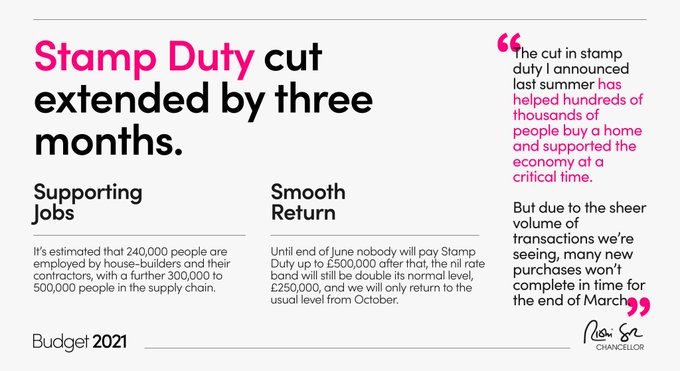
The government has announced that the temporary stamp duty holiday in England and Northern Ireland has been extended until the end of June.
The news will hopefully come as a relief to those buyers and sellers who have been desperately trying to get their sale completed in time to meet the previous deadline of 31st March.
What is the temporary stamp duty holiday?
The temporary stamp duty holiday, first announced by the government on 8th July last year, means that if you are buying a home up to the value of £500,000 you will not pay any stamp duty.
The extension means you now have until 30th June to complete on the purchase to make the stamp duty saving.
Then, to smooth the transition back to normal, the nil rate band will be £250,000, double its standard level, until the end of September.
It will return to the usual threshold of £125,000 on 1st October.
There hasn’t been any further update from Scotland on any extension to the Land & Buildings Transaction Tax (LBTT) holiday, which is currently due to end on 31st March 2021.
In Wales, temporary Land Transaction Tax reductions are also set to end on 31st March, but we’ll let you know if this changes.
Are there delays in the home-moving process right now?
When the announcement was first made in July we recorded our busiest ever day on Rightmove, as people rushed to see if they could move home and make use of the savings, leading to a huge increase in the usual number of sales that would be going through the legal process.
We estimate that there are currently 628,000 sales going through, and this massive number, coupled with the challenges of conveyancers, solicitors and councils working from home, has led to delays in the home-buying process.
Our latest data shows that it is taking an average of 65 days from the time a seller has a property listed by an agent on Rightmove until they get an offer accepted, and a further 126 days to get through to legal completion, which is almost seven months.
But remember these are averages, and other factors such as if you are a cash buyer or if council searches in your area take longer will affected how long it takes.
What do the experts say?
Our resident property data expert Tim Bannister explained that the stamp duty holiday extension should give tens of thousands of home-movers the chance to complete before the new deadline.
He said: “This three-month extension will come as a huge relief for those people who have been going through the sales process since last year and were always expecting to make use of the stamp duty savings.
“Our recent data shows one in five sales that were agreed in the same month the stamp duty holiday was first announced in July last year still haven’t completed, so this additional time will make a big difference to help those stuck in the logjam complete their purchase in time before the new end of June deadline.
“Buyers who have recently agreed a sale now have a race on their hands to see if they can also make use of the stamp duty savings, but many with purchases over £250,000 will find that time is too tight to complete before the end of June and so shouldn’t be factoring this into their purchase.
“It’s worth remembering that the average savings vary massively around England, and first-time buyers will still be exempt if they’re buying for £300,000 or less. There are also many other reasons people are choosing to move, evidenced by the strong buyer demand Rightmove has already seen in the first two months of the year.”
The announcement of a third national lockdown was difficult news for many to hear at the start of this new year, but hopefully the following information will put you at ease with what you can expect from us during this difficult time. We have always, and will always take the steps needed to ensure the safety of our staff and clients – it’s our number one priority. Within the new guidance, you can still move home and attend viewings, and our teams continue to work in a Covid-safe manner.
Before the property viewing:
• V&H Homes employees will check that everyone involved in the visit is feeling well, and if anyone has been experiencing Covid-19 symptoms in the last 14 days, the visit will be postponed
• It will be requested that a maximum of two people (from one household) plus a V&H Homes representative are present at viewings
• V&H Homes will ask the occupant or owners to ensure the property is well ventilated and door are open prior to a visit
• V&H Homes will not be able to provide transport to or from the property
During the property viewing:
• V&H Homes representatives will maintain a 2m distance during the visit with everyone present
• If the property is not large enough to maintain two metres distance, a ‘one in one out’ policy will apply
• Antibacterial gel will be used on arrival and during the visit
• V&H Homes will provide disposable gloves and face covering for our staff and any customers visiting the property
• If there is a need to open doors or cupboards, the V&H Homes representative will do this. Customers will be asked not to touch any surfaces inside the property or any pets present
If you are considering selling or letting your property in Ashtead, Leatherhead, Fetcham, Epsom, Bookham or the surrounding areas, call V&H Homes on 01372 221 678

The housing market is to remain open during the second lockdown in England.
Uncertainty over whether estate and letting agencies will be classified as essential services under Thursday’s lockdown rules, has been clarified.
In a statement to the industry, the Government says: “Buying, selling and renting a home can continue, in a COVID-secure way, as it has in recent months. Estate and letting agents can operate, show homes and sales suites can remain open and property viewings, mortgage valuations and surveys can take place.”
Subject to approval, the regulations specifically state that activities relating to the sector are allowed to continue under exceptions to leaving home to undertake any of the following activities in connection with the purchase, sale, letting or rental of a residential property:
- visiting estate or letting agents, developer sales offices or show homes;
- viewing residential properties to look for a property to buy or to rent;
- preparing a residential property to move in;
moving house; - visiting a residential property to undertake any activities required for the rental or
- sale of that property.
V&H Homes have been operating under the Covid-19 Secure Guidelines since May and will continue to prioritise the saftey of our clients and staff whilst we remain fully operational.
We cover property sales and property lettings in Ashtead, Leatherhead, Fetcham, Epsom, Bookham and the surrounding areas.
If you are looking to sell, let, buy or rent a property, or if you are just looking for some advice, please call us on 01372 221 678.

If you’re the sort of person who enjoys watching shows like Homes Under the Hammer and thinks “I could do that!” then you’ve probably considered becoming a landlord at some stage.
But being a landlord is a tough business, and despite what some people may think, it’s not a licence to print money.
So, Rightmove have spoken to The Secret Landlord – who’s been letting, refurbishing and selling properties across the UK for almost two decades – for her top tips on what it really takes to succeed as a landlord.
An award winning landlord, as judged by the National Landlords Association, The Secret Landlord has provided accommodation for hundreds of tenants from all walks of life.
Scroll down to read their Q&A for some expert insight and hopefully you’ll learn plenty of top tips along the way!
RM: How important is budgeting as a landlord?
SL: It’s easy to get caught up and think little odds and ends don’t matter too much, but they do. Every penny of expense should be recorded and submitted. Accurate records need to be kept at all times. This will also make your life easier when they do make tax digital.
Too many investors worry about the big ticket items and don’t spend enough time thinking about the smaller spends. Money leaks out of businesses in weird and wonderful ways and you need to do your best to understand where it does to be sure you’re running an effective operation.
RM: How do you approach rent increases?
SL: Rent increases are controversial, especially when they involve long term good tenants. Rewarding tenants with no rent increases is one strategy, however another approach is to look at biennial incremental rent increases (market factors permitting). Small rises are an opportunity for you to remind good tenants they are being rewarded with a lower than market rate and allow you to build an ‘improvement pot’ to ensure your property remains in good condition.
It’s also important to understand the value of your business as a landlord where, unlike a homeowner, you will be a repeat customer for many trades and suppliers. This means you should seek out the best prices and service levels to provide the most you can for your tenants.
RM: How do you deal with things going wrong?
SL: No matter how much you try and future-proof and fool-proof a property it will always go wrong. Entropy is a fact of life. As an investor you must understand things will always decline, a roof will never fix itself and a problem will never go away until you solve it.
Solving problems always costs money and takes time and those things need to be factored in. Things will always take longer and cost more than what you initially expect, so it’s best practice to add another 10-20% to any estimate. If it comes in at price, you’ll be pleased with the ‘saving’.
RM: Is there much paperwork involved?
SL: Paperwork is a pain, but it’s also critical to ensuring you run a safe and reputable business. Records need to be kept of all ASTs, deposit certificates, gas and electrical work and ensure you diarise when things become due. Gas safety checks are annual, electrical checks are every five years, EPCs every ten years.
There are many free and low priced technical solutions available for making the headache of paperwork less stressful, which should be explored and used. Having adequate insurance is crucial, it’s best practice to also include legal expenses. Insurance is only as good as the policy small print, so it’s best to ensure you have a comprehensive one that fits your needs, not just the cheapest.
Be on top of when any guarantees, warranties and mortgage deals expire and shop around at least one month beforehand. Being prepared is key to getting the best deal.
RM: What’re your top pieces of advice for aspiring landlords?
SL: To make it as a landlord you need to be prepared for anything and everything to happen at a moment’s notice. It’s important to educate yourself and keep up-to-date with changing legislation. Landlord organisations are only a few pounds per month and offer excellent guidance along with helplines. There are also many resources available from property blogs to property forums and books. Building up a sinking fund is crucial and it’s advisable to save at least 15% of your rent for rainy days.
Like any business, buy to let has seasonal variances. Winter is worse for roof repairs, autumn for boiler problems and spring for windows and fencing. Adjust your budget so you can be ready for the year ahead. If you’re concerned by expensive boiler repairs, consider taking out a policy which protects the boiler in the event of an emergency.
Unfortunately, you cannot stop problems occurring, but the best course of action is to be prepared for when they do. If you’re going on holiday, or live far away from a property, it might be useful to take out an emergency policy to ensure repairs can be dealt with swiftly.
It’s not easy to always expect the unexpected, but planning ahead, keeping accurate records, having a good network of people and an emergency budget will help you sail through many storms.
If you are considering selling or letting your property in Ashtead, Leatherhead, Fetcham, Epsom, Bookham or the surrounding areas, call V&H Homes on 01372 221 678

According to tax specialist, Imogen Lea, financial penalties due to ‘seismic’ changes to CGT payment rules could heavily impact people selling buy-to-let properties.
From April 6th, anyone who disposes of a residential property giving rise to a capital gain on which CGT is payable, will be required to make a digital return to HMRC and to pay an estimate of the CGT due within 30 days from the sale completing.
People will also no longer be able to benefit from a possibly substantial sum of money remaining in their hands for up to 22 months after residential property disposal.
Imogen, a consultant in Clarke Willmott’s Taunton private capital team, says: “This is a very big change and could easily catch people out. Interest on the unpaid tax and other financial penalties will be due if the rules are not followed. The risk of such a tight turnaround is people being unaware of the changes and failing to comply. They need to be aware of the vastly reduced time limits and to be ready to make the return and estimate the CGT due.
CGT computations are not always straightforward, which could mean that if people are not prepared, they might not be able to collate the information necessary to make the CGT calculation in time.”
The changes will potentially affect owners of holiday homes, buy-to-let properties, main residences which have been let out at some point, owners of homes with grounds in excess of half a hectare, and owners of houses which have been partly used for business purposes.
Imogen says the changes will not generally apply on the sale of a person’s main residence, but will be relevant on the sale of second homes, and where the main residence exemption does not apply for any reason.
“Gains are not always straightforward to calculate – if an owner has made improvements to the property the cost of these will be deductible from the capital gain, but if there have been numerous improvements over many years it may be challenging for the client to find all the supporting documentation.”
Imogen urges property owners to make an early start of compiling the required information and to start thinking about the CGT position as soon as the property goes on the market.
CGT is calculated by treating the gain as the highest amount of the owner’s income during the tax year in question, and therefore clients will need to estimate their income during the tax year of disposal as this will impact on the CGT rate applicable to the gain.
Personal representatives and trustees, as well as individuals, will be required to comply with the new rules. Meanwhile, gifts of properties also give rise to a disposal for CGT purposes triggering the new requirements.
John Bunker, chair of Chartered Institute of Taxation’s private client UK committee, has branded the new reduced deadline as “a seismic change”.
If you are interested in buying selling or letting a property in Leatherhead, Fetcham, Ashtead, Bookham, Epsom or surrounding areas then please call the office on 01372 221 678 to speak to a member of the team.

As millions woke up on Fri 13th to the general election result, ‘Property Reporter’ takes a look to see how the property industry has reacted. So, the votes are all in. They have been counted and the UK has spoken. As usual, the property industry was quick to react to the result. Here’s what they are saying:
Saul Empson; Harringtons: “For the wealthy, this is a hugely comforting outcome – they have the party of their choice in power with a majority, and buyers and sellers can all get on with their lives and push forward with the moving plans that they’ve been sitting on for quite some time.”
Nina Harrison; Executive at Haringtons Buying Agency, commented: “I would expect prices to increase – they won’t race up, but prices will definitely strengthen in Central London as more people start to buy and sell again.”
Caroline Takla; Founder of prime London buying agency; The Collection: “Today’s result will be doomsday for a lot of high value deals. I know many buyers who categorically wouldn’t exchange until after the election result, so today, many purchasers and vendors alike will be happy knowing Corbyn’s name is now confined to the history books. A Conservative majority is the outcome most likely to deliver stability and much needed certainty to the market, and one that many of my clients were hoping for. On a local level, there will be more confidence in the market. It will be perceived as a direction of travel. Whilst the precise details of our future relationship with the EU are still not formed, much of the Brexit effect has been priced into the market already. The market will buoy initially, but as these details continue to unfold there will still be buyers who will hesitate before committing.”
Guy Harrington; CEO of property lender Glenhawk: “Finally some light at the end of the Brexit tunnel. This result, coupled with finally leaving the EU in January, is the tonic the real estate market’s been waiting for. Expect improved liquidity, greater transaction volumes, a stronger pound and a bounce in the housing market, all of which will benefit lenders, investors and developers alike.”
Walter Mythen, New Homes Director at JOHNS&CO: “This is the best outcome for the property market, although we anticipate growth will continue to be slow for the foreseeable future as people recover from the hangover of the last three years of political instability. A Tory majority gives us some much-needed clarity and will result in a quicker bounce back to a ‘normal’ market. We wouldn’t expect any dramatic increases or decreases in the market, but buyers and sellers will finally be able to get moving. We may well see the return of the casual investor too – who had all but disappeared in the last three years of political instability.”
Richard Pike at Phoebus Software: “People have voted for a resolutional Brexit, but what does a Conservative majority mean for our Sector? The fact is, a stronger pound, a surge in the money markets and, based on campaign policy, this should be good for all.”
Jamie Johnson; CEO of FJP Investment: “Many will be somewhat relieved with this result – a Conservative majority means we are a step closer to ensuring Brexit will be finalised in some shape or form come the end of January 2020. As expected, there have been some significant movements on the financial markets which is to be expected. Once an election result is announced, the markets will naturally take time to adjust to the news, before once again becoming stable. Of all the possible outcomes to come from the yesterday’s election, a Conservative majority provides the most clarity. Their position on Brexit is clear, and now we wait for Boris Johnson’s EU Withdrawal Agreement to once again be voted on in parliament. Importantly, I hope the government uses this victory to start making progress on national issues that have been ignored; such as the property market.”
Nick Leeming; Chairman at Jackson-Stops, comments: “Over the last few years, both buyers and sellers have done well to adjust to the ongoing uncertainty facing our country, yet we hope that today’s result will finally provide some reassurance to the property market. Throughout the Conservative party’s campaign they pledged their support for greater home ownership and so now is the time for them to form a Government that will deliver on this.
In the lead up to Boris being elected Prime Minister, he spoke widely about stamp duty cuts for UK residents, yet this quickly fell by the wayside as he settled in to No.10. Our latest research found that 41% of consumers think there should be a wholesale reduction in stamp duty across all price brackets, while more than a quarter think Government should abolish stamp duty on all homes under £500,000. Just 3% felt no change was required, which highlights the need for change.
It was therefore disappointing to see the party’s manifesto only focussed on increasing the amount of stamp duty payable for non-UK residents – done in an attempt to take the heat out of the property market. If we are to give the economy the much-needed boost it needs, what we actually need is to reduce the burden of stamp duty across the wider UK housing market.
Although we still have Brexit to contend with, housing must continue to be a key priority for the Conservatives. People are of course still moving. Buying and selling property doesn’t simply stop because the UK is leaving the EU or there has been an election – there are often overriding reasons for moving, whether to be closer to a good school, better childcare or the need to upsize or downsize.
Yet it is quite clear that if our Government wants to see a more fluid property market, which is moving at all levels, then it needs to provide far greater support to key demographics such as first-time buyers, young families and downsizers.”
Paresh Raja, CEO of Market Financial Solutions: “In many ways, today’s result shouldn’t come as much of a surprise. The Conservative Party’s main election pledge has been to ‘get Brexit done’, and the result suggests people are longing for the issue to be resolved come 31stJanuary 2020. What’s more, a majority government means we’re less likely to see a legislative deadlock in Westminster as has been the case since the last election.
For the property market, this is good news. Investors have been yearning for greater certainty and while national house prices have been steadily rising as a result of sustained demand, many have adopted a wait and see approach before committing to a real estate purchase. This result provides some much-needed clarity, and I’d expect to see an increase in property transactions over the coming months.
There are plenty of question marks hanging over the newly-elected government. When will the long overdue budget be delivered? Will there be changes to taxes like stamp duty? How will the housing crisis be addressed? I hope the Prime Minister addresses these questions and does not let Brexit continue to overshadow pressing national issues.
For now, at least, all eyes are turned to the end of January when Boris Johnson’s commitment to deliver Brexit will be put to the ultimate test.”
Jerald Solis, Business Development and Acquisitions Director of Experience Invest: “Despite winning a majority, the Conservative party should view this only as a minor victory. Whilst this was dubbed a ‘Brexit Election’, the public has made it clear that other pressing issues must be pushed to the forefront of the newly elected government’s agenda, such as the housing crisis.
Research from Experience Invest has shown that just 11% of consumers had faith in Boris Johnson’s previous government to solve the problem. So, the question now is how his new government will ensure the appropriate measures are put in place to ensure more people are able to jump onto the property ladder. From the promise to build 29,000 affordable homes, to simplified shared ownership and help to buy loans, the public will be expecting creative action.
One of the main public concerns will now be whether the government will meet the Brexit deadline of 31st January or seek another extension. After all, with over half (53%) of consumers Experience Invest surveyed agreeing that prolonging Brexit is counterproductive to solving the housing crisis, we cannot let Brexit overshadow pressing national issues that have been ignored for far too long.”
Liam Bailey, Global Head of Research at Knight Frank, said: “The Conservative Party has won a majority of just under 80 seats in the UK general election. As a result, the UK is likely to leave the European Union on 31 January, with a vote in Parliament and a Queen’s Speech expected before Christmas.
This will, for the time being, end the uncertainty of a no-deal Brexit and pave the way for the release of some of the pent-up demand that has built in property markets in recent years. The extent to which this translates into transaction activity in the short-term will depend on the size of the pricing expectation gap between buyers and sellers.
Supply is likely to rise as political uncertainty recedes and private and public spending stimulate the UK economy. This will put downwards pressure on prices, however some vendors may expect a bounce in prices, which may create a stand-off between buyers and sellers as the market re-prices.
A shortage of supply in the lettings market may be further exacerbated as owners attempt to capitalise on any perceived ‘bounce’ and list their property on the sales market, which would put upwards pressure on rental values.”
Randeesh Sandhu, CEO of Urban Exposure said:“The Conservative majority delivered at the General Election is the best result for the UK property sector. They are clearly the party that has been and looks set to continue to support home ownership with a series of initiatives in their manifesto focussed on supporting first time buyers, such as the proposed mortgage deposit scheme.
We expect the housebuilding market to also be boosted by a resurgent UK economy in 2020, particularly as and when Brexit is resolved. The RICS survey yesterday showed the property industry believes getting Brexit done will trigger surge in housing market and we very much subscribe to that view. The prospect of a trade deal will have a positive impact across supply chains, as well on demand, as greater certainty breeds improved confidence throughout the sector. Although the timing of any deal is clearly not confirmed, the UK economy and property sector starts from a position of strength, with the ongoing growth in wages outpacing inflation which, in turn, should keep interest rates at record lows. All this adds up to healthy picture for UK housing demand.”