
Want to know what your property is worth?
Want to know what your property is worth?
SEARCHING FOR MORE SPACE THIS SUMMER?
Here's why you should sell your property this summer...
1. IT'S A PERFECT TIME TO SHOWCASE YOUR PROPERTY
If you are looking to showcase your most valuable asset, summer gives you the chance to ‘wow’ potential buyers and sell them the dream they’ve been looking for. With the garden in full bloom and sunlight streaming through the windows (when the UK decides!) buyers will love looking around your home.
2. SERIOUS BUYERS & SELLERS
Sometimes there are less properties on the market in Summer, however the buyers and sellers looking tend to be the most serious ones!
3. GET SETTLED BEFORE THE NEW TERM
Buyers with children will be keen to have them settled in before school term starts. What’s more, with glorious weather, moving home can actually be a great experience.
More than a quarter of UK homeowners and renters have claimed that their property priorities have changed since the COVID-19 outbreak.
Previously highly-sought after and high-value property features have dropped down the priority list for home buyers and tenants, as they now seek different factors when looking for a property that meets their needs and lifestyles.
Easy commutes to work, proximity to local shops and restaurants, and local public transport links are no longer as desirable as they once were.
Instead, we have noticed a significant increase in those searching for more space, whereby those searching are willing to compromise on location or local amenities in return for larger bedrooms and a 'work from home' zone.
Having access to a private garden or nearby green space has also become one of the top preferences for homebuyers and renters, especially in light of reduced travel options this summer.
If you need more space, call V&H Homes on 01372 221 678 to see how we can help.
This article was extracted from Rightmove for informational purposes
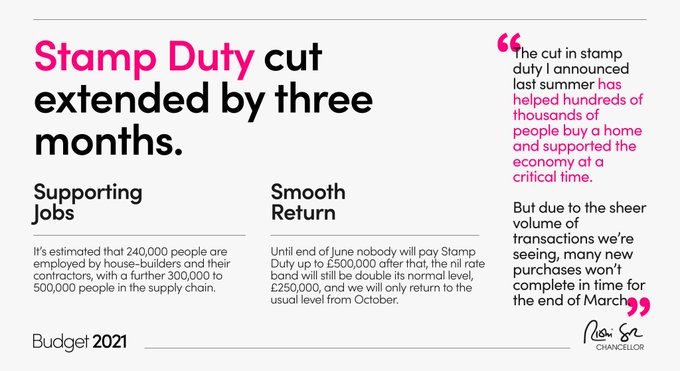
The government has announced that the temporary stamp duty holiday in England and Northern Ireland has been extended until the end of June.
The news will hopefully come as a relief to those buyers and sellers who have been desperately trying to get their sale completed in time to meet the previous deadline of 31st March.
What is the temporary stamp duty holiday?
The temporary stamp duty holiday, first announced by the government on 8th July last year, means that if you are buying a home up to the value of £500,000 you will not pay any stamp duty.
The extension means you now have until 30th June to complete on the purchase to make the stamp duty saving.
Then, to smooth the transition back to normal, the nil rate band will be £250,000, double its standard level, until the end of September.
It will return to the usual threshold of £125,000 on 1st October.
There hasn’t been any further update from Scotland on any extension to the Land & Buildings Transaction Tax (LBTT) holiday, which is currently due to end on 31st March 2021.
In Wales, temporary Land Transaction Tax reductions are also set to end on 31st March, but we’ll let you know if this changes.
Are there delays in the home-moving process right now?
When the announcement was first made in July we recorded our busiest ever day on Rightmove, as people rushed to see if they could move home and make use of the savings, leading to a huge increase in the usual number of sales that would be going through the legal process.
We estimate that there are currently 628,000 sales going through, and this massive number, coupled with the challenges of conveyancers, solicitors and councils working from home, has led to delays in the home-buying process.
Our latest data shows that it is taking an average of 65 days from the time a seller has a property listed by an agent on Rightmove until they get an offer accepted, and a further 126 days to get through to legal completion, which is almost seven months.
But remember these are averages, and other factors such as if you are a cash buyer or if council searches in your area take longer will affected how long it takes.
What do the experts say?
Our resident property data expert Tim Bannister explained that the stamp duty holiday extension should give tens of thousands of home-movers the chance to complete before the new deadline.
He said: “This three-month extension will come as a huge relief for those people who have been going through the sales process since last year and were always expecting to make use of the stamp duty savings.
“Our recent data shows one in five sales that were agreed in the same month the stamp duty holiday was first announced in July last year still haven’t completed, so this additional time will make a big difference to help those stuck in the logjam complete their purchase in time before the new end of June deadline.
“Buyers who have recently agreed a sale now have a race on their hands to see if they can also make use of the stamp duty savings, but many with purchases over £250,000 will find that time is too tight to complete before the end of June and so shouldn’t be factoring this into their purchase.
“It’s worth remembering that the average savings vary massively around England, and first-time buyers will still be exempt if they’re buying for £300,000 or less. There are also many other reasons people are choosing to move, evidenced by the strong buyer demand Rightmove has already seen in the first two months of the year.”

The rent or buy debate is a pretty controversial topic with no simple answer, but we want to put paid to the ever-present myth that buying is always better than renting.
But renting doesn’t mean you are throwing away money in the same way that buying a home isn’t always the right decision at certain times in your life. So we’ve come up with a list of 12 reasons why renting might just be the better option for you.

1.No maintenance costs or repair bills
When renting a property, your landlord is usually responsible for all maintenance and repair costs, ensuring you don’t have the financial responsibility to get these things fixed.

2. No large down-payment
Renters have the better financial deal upon signing as a house with a mortgage requires a sizable down payment compared to the usual deposit for renting a property.

3. There’s a fixed rent amount
Rent amounts are certain for the span of the lease agreement – so long as it’s a fixed-term contract – making it easier to budget your money so you know exactly how much you’re required to pay.

4. You can keep things flexible!
When you buy a house you are tied down to living in that location for at least a few years usually, whereas if you’re renting a property you have the flexibility to move around if something changes in your life or outlook.

5. You have the options for housemates
Housemates are many things – from being someone to split the bills with to potentially becoming some of the best friendships you may ever have.

6. Invest money on your own terms
Choosing not to buy a home – at least for the moment – opens up other possibilities for saving and investing so you can choose exactly where your hard-earned money is going.

7. Generally lower utility costs
Rental properties typically have a more compact floor plan, therefore renters can often expect to face lower utility costs – another money saver.

8. Enjoy being mortgage-free
By renting you can put away as much (or more) savings as a homeowner, but without the debt that comes along with owning a property.

9. Urban living at a cheaper price
Depending on where you want to live, trendy areas, such as major cities, and beach communities, are typically more renter friendly.

10. Decreasing property value
Property values go up and down over the years depending on the area you live, and, while this may affect homeowners in a big way, it affects renters substantially less so, if at all.

11. Excuse yourself from costly updates
As a renter, there is freedom in knowing you couldn’t remodel your home even if you wanted to, so this a way of saving money.

12. Insurance is cheaper
Renter’s insurance is significantly cheaper than the insurance home owners have to pay.

So there you have it. It’s likely you already have your own opinion about whether renting or buying is right for you now – or in the future – but hopefully this article has given you a few reasons to show that renting can be seriously advantageous for many of us.
If you are considering selling or letting your property in Ashtead, Leatherhead, Fetcham, Epsom, Bookham or the surrounding areas, call V&H Homes on 01372 221 678

We’re not used to spending so much time in our homes, but whilst we are, it’s important that we make the most of it.
It gives you a chance to play more with the kids and also see to those bits of DIY that you have either not been able to get round to doing or purposely avoided.
There’s no getting out of them now and you shouldn’t want to as they will benefit your home life.
Show your home some love with these three simple DIY jobs and it will love you back:
Add a lick of paint to those rooms in need of it!
One of the quickest and most effective ways of reviving a room is to patch up any paintwork that’s looking untidy. Hopefully, you might have a tin of the original paint lying about somewhere and a few paintbrushes stashed away.
For a more drastic transformation, change a colour scheme completely by fully repainting a room in a fashionable shade.
As it’s now spring, a sage or olive green colour seems fitting, or try a cheery yellow.
To get a combination of colours, paint your skirting boards and doors in different finishes.
Do a bit of fixing and recycling
It’s unheard of for a home to have nothing that needs fixing – there’s always something in need of repair.
Certain pulls, handles and knobs on your cupboards could be loose and need tightening or a fence panel in the garden wants mending. You can sort this yourself rather than pay someone to come and remedy them for you once lockdown is over.
If you’re a hoarder, now would also be an apt time to repurpose any rarely used items you have in the house.
Get your garden organised for spring / summer
Being stuck indoors for so many hours of the day can be tough, so use your garden at every opportunity to breathe in some of that fresh air.
In ordinary circumstances, we’d encourage you to bring the outdoors indoors, but current circumstances demand a reversal – taking the indoors, outdoors.
So get that garden furniture and those bean bags out so that you can relax in the sunshine, whilst the kids take to their swings and slides.
Give the garden a good tidy first to maximise the space, donning your gardening gloves for all that mowing, weeding and preening you need to do.
If you are considering selling or letting your property in Ashtead, Leatherhead, Fetcham, Epsom, Bookham or the surrounding areas, call V&H Homes on 01372 221 678

The following information was extracted from Rightmove.
The government has extended the ban on evictions it put in place to protect tenants struggling as a result of the coronavirus.
The move means that eviction notices – which could have started again on 11 January – must not be served for at least another six weeks in England, until 21 February.
In Wales, eviction orders have been banned for longer, until the end of March.
Scotland has also implemented an evictions’ ban until 31 March in all areas subject to level of restrictions three or four.
Last March the government passed the Coronavirus Act, which among other things, made it illegal for landlords to evict renters for a specified amount of time.
This also meant that irrespective of the type of tenancy, or what kind of notice was served, or for whatever reason, all notice periods for evictions were extended from three to a minimum of six months.
The six-month minimum notice period is in place until at least the end of March, and is being reviewed periodically.
There are only a few exceptions to the ban and extended notice periods, such as cases involving anti-social behaviour or domestic abuse.
What happens if a tenant is struggling to pay the rent?
The best thing for tenants to do is speak with their landlords as soon as possible to explain their situation and attempt to set up a feasible plan.
The government has said that it’s important landlords offer support and understanding to tenants who may start to see their income fluctuate.
There is no specific plan that a landlord needs to agree to, so it’s important that tenants, letting agents, and landlords work together to find solutions that will work for everyone.
If you’re a tenant, it’s also worth speaking with your local authority, as there may be help available for you.
I’m a landlord, and my tenant is causing problems. What are my options?
There simply is not a ‘one size fits all’ approach to this. Landlords are urged to, where possible, work collaboratively with their tenants to come to mutual agreements.
In cases involving anti-social behaviour or domestic abuse, or if tenants have built up more than six months’ rent arrears, landlords may apply for a court order, as there are exceptions in place for these.
However, there could be a backlog of eviction cases in the pipeline, and it’s possible landlords will not be able to gain possession of their properties for a while.
One option is to consider mediation. Organisations such as the Property Redress Scheme and The Property Ombudsman offer mediation services between landlords and tenants to aid finding a resolution over issues which have arisen during a tenancy.
Mediation is a voluntary, impartial and confidential process, which allows disputes to be resolved much quicker and with less cost than going through courts.
If you are considering selling or letting your property in Ashtead, Leatherhead, Fetcham, Epsom, Bookham or the surrounding areas, call V&H Homes on 01372 221 678

Where our homes seemed bright and spacious during the summer while enjoying the sunshine outside, things can suddenly seem a whole lot more cramped when the colder weather forces us back inside, leading to the inevitable conclusion that we desperately need more space.
The idea of looking for a bigger home with more space often gives people concerns about how much it will cost to take on a larger property and whether the benefits outweigh this. While a higher cost is naturally unavoidable when beginning this house-hunting journey, it really can make a huge difference to you and your family’s lives, giving you all that little bit more room to grow.
Needing more room for family and friends to stay (and to escape them when needed)
Often one of the triggers that most often inspires the desire to move somewhere bigger is having guests come to stay for a visit, especially the in-laws. Suddenly, a home that once felt spacious seems that little bit too overcrowded when it has an extra person or two taking up space.
Wanting more space to create your individual ‘forever home’
Each of us have different priorities and visions when it comes to creating our true dream home. For some of us it’s a simple as wanting more storage at home while others dream of having a beautiful garden to enjoy or an extra bedroom. Often the trigger for wanting a bigger property is about giving yourself a fresh canvas to start creating that dream home for yourself.
Desiring flexible space at home that can suit every need
Having that extra bedroom is probably the most common motivation people have for deciding to upsize, mainly because of the flexibility it allows. The room can simply be left as a spare bedroom for guests or a new flatmate, but equally it could also become storage space, a room to workout in or even a dressing room.
Dreaming of a home that can grow alongside you and your family
Sometimes needing more room to grow isn’t always about moving to a ‘bigger’ house in the literal sense. It’s also about choosing a property that has the potential to grow and change as and when you need it to, whether that’s being able to extend and build onto the existing home or converting rooms to fill a different function as and when your life changes.
Is it time for you to upsize?
It’s likely that all of us, at some point or another, will start to have that niggling feeling that we are running out of space and it’s time to look for something new. While moving home isn’t a decision to be taken lightly, it’s always worth focussing on the positives and not just the worries and concerns we all have when taking that next step.
While everyone’s motivations can be different, if some of these triggers sound familiar to you, it may be time to start thinking about whether now is the time to look for a place with a little more room to grow.

The following information is taken from Rightmove...
"The property market has experienced a mini boom in 2020, and the big question many of you want answered is: will prices continue to rise in 2021?
Whilst we don’t have a crystal ball, we do have the biggest home-hunting audience in the UK, as well as unique insight into future demand for property.
So armed with all that data, we’ve produced a forecast of what we think will happen to property prices in 2021.
Our main prediction is that the recent surge in average asking prices will continue into next year, as the nation’s housing needs are likely to outweigh any economic uncertainty.
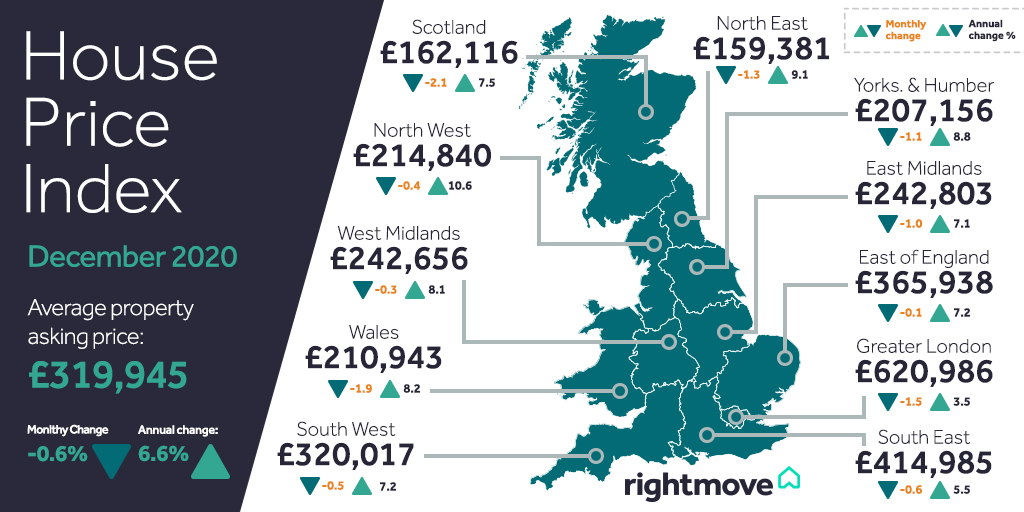
Specifically, we forecast a robust 4% national average house price growth in 2021. However, we think that the price rises will be at a slower pace than this year, which finished 6.6% up on 2019.
What can we expect from the property market in 2021?
It will be a busy start to 2021. The New Year is typically a time for resolutions for the year ahead, and many will see it as an opportunity to draw a line under 2020, which may well include a fresh start in a new home for those who have not already acted.
Many of you have already done so this year, and many more are continuing to do so despite the seasonally quieter run-up to the Christmas period and the declining chance of completing a purchase before the stamp duty deadline in March.
Despite the clock ticking, around 130,000 sales were agreed over the last month, up by a remarkable 44% on the same period in 2019.
However, there remains a processing logjam and some completions are already projected to be delayed until April next year, especially where there are search delays, legal issues or complex mortgage applications.
What will happen when the stamp duty holiday ends?
It will be a slower second quarter once the stamp duty holiday is over, though even with the average price in Britain up by 6.6% this year, cheap mortgage rates that are available for some leave scope for further modest price growth – despite the loss of the tax saving.
What do the experts say?
Rightmove's resident property data expert Tim Bannister explained that it may be quieter in the market in the spring.
He said: “2021 has a lot of variables, and so is not an easy one to call, but with Rightmove’s unique leading indicators of buyer and seller behaviour we are confident that the housing market will continue to outperform general expectations next year as it did this.
“Our 2021 forecast of a 4% price rise is more conservative than the unsustainable 6.6% national average seen this year. There’s likely to be a lull in quarter two unless the stamp duty holiday is extended, but for many buyers its removal will not be make or break, though may lead them to reduce their offers to a degree to compensate for the higher tax, and indeed many sellers may be prepared to help to mitigate their buyer’s financial loss.
“First-time buyers will remain largely exempt, so in most cases will be no worse off. The maximum savings of £2,450 in Wales or £2,100 in Scotland are considerably less decisive than the £15,000 available in England for a house costing £500,000 or more, which does however only apply to a small part of the market.”
If you are considering selling or letting your property in Ashtead, Leatherhead, Fetcham, Epsom, Bookham or the surrounding areas, call V&H Homes on 01372 221 678

Moving home is exciting. It’s also hard work – and sometimes we end up spending a little more than we hoped to.
Some expenses are necessary and can’t be avoided: agent fees, deposits, mortgage fees, stamp duty, and so on.
But there are plenty of things you can do to save you money as you’re moving home. We’ve listed nine easy and effective tips that’ll help cut down your costs – and leave a little more in the piggy bank for the decorating!
1. Plan ahead
A good chunk of moving expenses are those last-minute snags you forgot about.
Having to get cleaners in because you realise you won’t have the time to do it yourself; paying a premium price for the removals company because you miscalculated how much stuff you have; finding a storage facility for the items you couldn’t fit into your new place.
These are just a few examples, so if you do your best to plan and book things in the months and weeks leading up to the move, you’ll almost definitely save yourself a few bob – and stress.
Many of the next tips are linked to planning ahead, so here’s a checklist that will help you keep track of what needs to be done.
2. Compare removals services
There’s a lot of competition out there between removals companies to get your business, so make sure you get quotes from several different ones instead of going for the first one you find.
There are several comparison sites you could use that will help you find a company in your area that offers a competitive price and a good service. And remember that if you can book in advance you’ll probably get yourself a better deal.
It’s worth noting that because the market is so busy at the moment, it’s a good idea to book as far advanced as you can anyway so you’re sure to secure a slot.
Having said that, our next top tip is…
3. DIY as much as possible
If there’s any way you can hire a van and do the removals’ job yourself, you should definitely consider it. It is hard work, but it could save you hundreds of pounds.
You may find that as far as the amount of time it takes, the difference may be minimal. You’d need to be around to coordinate the ins and outs of a removal company anyway, so if you have the capability and help needed to do the carrying and shifting, you may as well.
This would be the time to get a hold of those friends and family who nonchalantly told you, “let me know if you need a hand with anything”. Rally the troops – you’ll be surprised at how far a free round of pizzas and beers can go!
Just remember to check what the government guidelines are, and if it’s safe to do so.
4. Avoid buying packing material
If you’re hiring a removal company, they may include packing material in their pricing. If not, here are some ways you could find free boxes:
- Supermarkets – many will happily let you have as many boxes as you’d like. Keep your eyes peeled for banana boxes (see what we did there?), as they’re properly sturdy and of a good size. Start collecting boxes in the weeks leading up to your move when you do your weekly shopping.
- Friends and family – many people hold on to empty cardboard boxes or reusable plastic ones for years in the hopes they’ll come in handy someday. Well, that day has finally arrived!
- Social media – it’s quite likely that a post saying you’re looking for free boxes will generate some positive responses.
Bubble wrap is another annoyingly expensive material. Start stocking up on old newspapers and you may find that that could do the job just as well.
5. Declutter
Do you really need to hold on to that old camping gear that you used once 12 years ago? Or that desktop computer you’ve kept since 2002 in case there are any files in the hard drive worth keeping? Or that food dehydrator that you inherited from your aunt?
Let’s face it, most of us have way more things than we actually need, or use. A house move is the perfect time to start anew and find all the stuff that is taking up precious space, and that we’ll end up getting rid of eventually anyway.
Not only has it been proven that decluttering can be great for our mental health, it also means you’ll save yourself effort, time, and money.
Removals fees depend very much on how much needs to be packed and moved, so the less you have, the more you’ll save.
6. Sell your unwanted items
It’s almost guaranteed that that item you’re about to get rid of is exactly what someone somewhere is looking for.
Your aunt’s food dehydrator? Someone might pay good money for it, and give it a whole new second life.
There are many online companies that have made selling second-hand items super easy. Who knows, you might be able to pay for your removals with the money you make from old unwanted stuff.
It’s also an environmentally friendly way of recycling things, so a win-win no matter how you look at it.
7. Sort out your change of address
This has to do with the first point of planning ahead.
There are services available that will redirect mail to your new address, but this comes at a cost – especially if you’re moving abroad, or if you’re more than one person.
You can avoid this extra expense by making sure you update your address with all the main organisations that might contact you via post. Such as these:
- Insurance providers
- Banks
- Doctors/dentists
- Energy suppliers
- Government bodies and local authorities (HMRC, councils, DVLA, etc.)
- Schools/colleges/universities
- Employers
- Online shopping platforms (Amazon, eBay, etc.)
- Phone contracts
8. Review your contracts and suppliers
Looking through broadband, phone, TV packages and energy providers to see if we’ve got a good deal can be a tedious task, and one that we put off forever, so now is the perfect time to do it.
First of all, make sure you cancel all your contracts on time. In many cases you’ll need to give a two-week or a month’s notice before cancelling, so check if this is the case with your suppliers, and avoid paying for a service you won’t be using.
Moving into a new place is the ideal time to rethink some of your monthly expenditures. Do you still need that top TV bundle with the 400+ channels?
Shop around and do a bit of research. You might find some enticing deals that are only available to new contracts.
9. Empty out the pantry and freezer
Most of us will have a stash of food that we’ve been storing for ages. It could be anything from tins and jars in the back of the cupboard, to frozen meat that we never remember to defrost on time.
Once again, now is the time to take care of this for once and for all.
In the weeks leading up to the move, set yourself the goal of not doing any – or less – food shopping until you’ve used up everything, or most, of the food you’ve been storing. You may have to get creative, and find some recipes that are not in your typical menu, but you may very well find this to be a good thing.
You’ll accomplish two things: cut down on your shopping bill for a few weeks, and reduce the amount of things you’ll need to pack. You know how fiddly it is packing all those random fridge items, so the less of them, the better.
Just make sure everything’s still in date, though!
If you are considering selling or letting your property in Ashtead, Leatherhead, Fetcham, Epsom, Bookham or the surrounding areas, call V&H Homes on 01372 221 678
The asking prices of property coming on to Rightmove increased in our last two monthly reports, but this month they’ve seen a dip of around £1,500.
Is this something for sellers to worry about? We don’t think so, as there are a few reasons for the slight drop.
Firstly, the stamp duty holiday on homes up to £500,000 is due to end on 31st March, and so sellers putting their property up for sale now are perhaps pricing a bit more realistically so that they have a better chance of a quick sale.
Secondly, asking prices usually drop at this time of year, and this month’s drop is actually lower than we’ve seen over the past few years.
The good news if you’re a new seller is that buyer demand is staying strong despite the second national lockdown in England. We saw an initial, temporary dip after the new restrictions were first announced, but demand was still up by 28% on the same days last year during the three days between the announcement and the lockdown.
The first six days of lockdown saw demand jump back up to being 49% higher than this time last year, as the market is still open and agents can still operate.
The temporary stamp duty savings that can be made vary a lot depending on the price of the property you’re buying.
We had a look andfound that demand and activity compared with October last year are strongest in the price bands and regions where buyers are set to make the biggest stamp duty savings.
For example, the number of sales being agreed for properties priced between £100,000 and £200,000 is up by only 16% on this time last year.
Whereas the number of sales being agreed in the £400,000 to £500,000 price band has more than doubled (+106%).
In terms of how quickly homes are finding a buyer, the national average is now at a record low of 49 days.
However, homes priced between £400,000 and £500,000 have seen a big drop of 23 days to secure a buyer, compared to the £100,000 to £200,000 band seeing a drop of just eight days.
Regionally, the south is performing best relative to last year for the number of sales being agreed, up by 72% in the East of England, and up by 69% in the South East.
But we now estimate that there are around 650,000 sales going through, which is up by a massive 67% on the same time in 2019, and we know there are delays in the process so communication is key for people trying to get their sale over the line.
What are the headline figures?
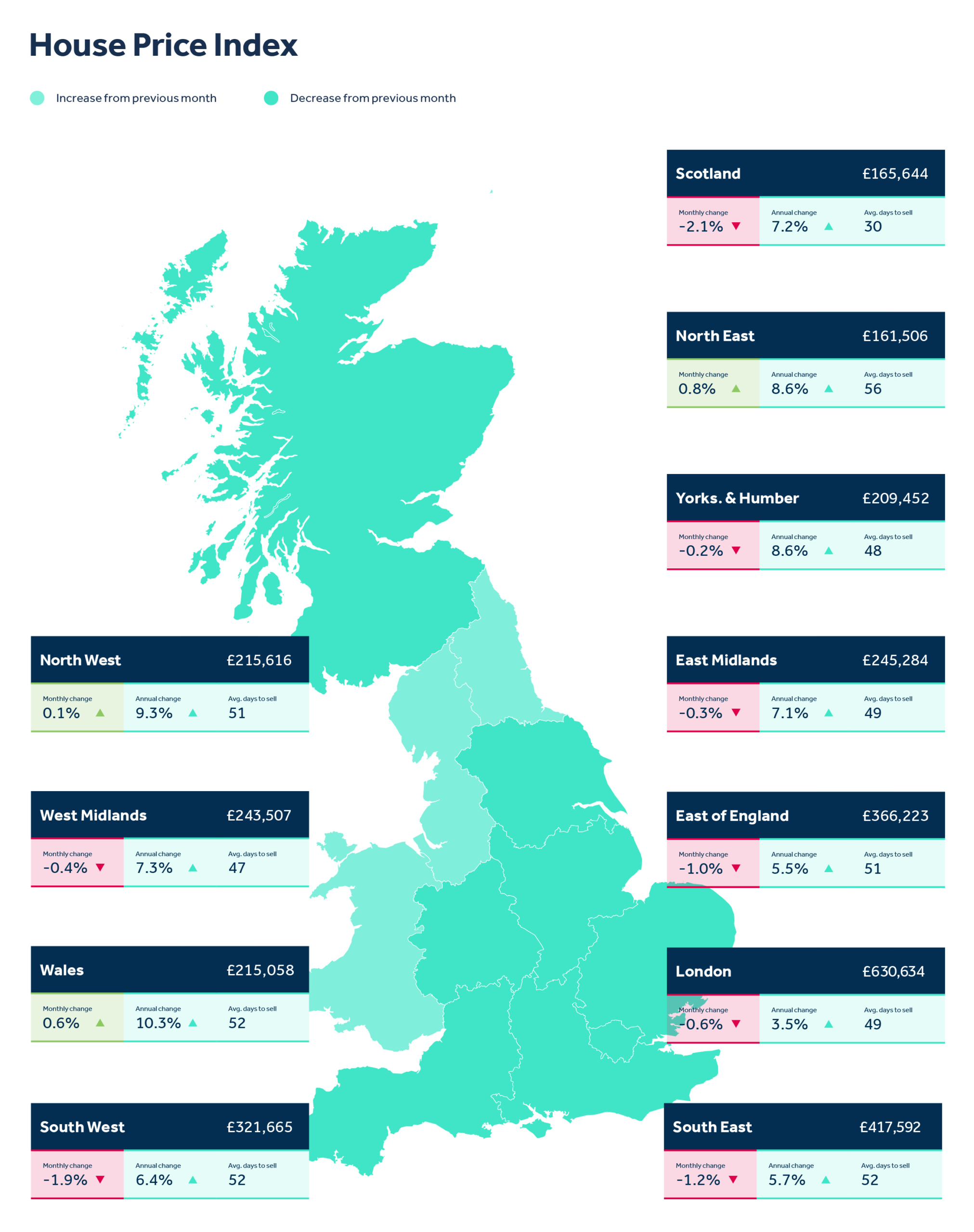
- Average price of property coming to market dips by 0.5% (-£1,505) from last month
- The number of sellers coming to market last month was up 35% on the same time last year
- National sales agreed are up 50% on October last year, and we estimate there’s 650,000 sales going through the buying and selling process, 67% more than at the same time in 2019
- There’s been a 106% uplift in sales agreed and a drop of 23 days in time to secure a buyer in £400,000-£500,000 band
- Buyers who were temporarily uncertain in run-up to the new lockdown in England have jumped back into action, with the first six days of the second lockdown seeing demand up by 49% on this time last year, as the housing market remains open
What do the experts say?
Our resident property data expert Tim Bannister explained that sellers are much more likely to find a buyer if their first asking price is realistic, rather than setting the bar too high to begin with and having to reduce the asking price at a later date.
He said: “Given the ongoing mini-boom, prices might have been expected to rise again this month, but instead we have a slight dip which could be a result of some new sellers pricing more realistically to have a better chance of agreeing a sale in time to benefit from the stamp duty savings on their onward purchase.
“We know from a recent Rightmove study that sellers are twice as likely to sell if they agree a sale based on the first price at which their property goes on the market, something that’s even more important now as we move towards the end of March and the end of the stamp duty holiday.
“If your initial asking price is too high then you’re less likely to get an offer even after you’ve cut your price back to a more realistic level. Our revised prediction of a 7% annual increase in prices in 2020 looks to be on track, since the annual rate has jumped to 6.3% with a month to go.”
What are estate agents seeing?
Bruce King, Director of Cheffins in Saffron Walden, said: “Sellers are taking a realistic view on pricing in the current market. By competitively pricing their homes they’re looking to entice buyers and agree a deal ahead of the stamp duty deadline, whilst also being able to benefit from stamp duty savings on their onward purchase.
“Transaction levels have gone through the roof in comparison to the past couple of years due to the monumental backlog of people looking to move. Political uncertainty, Brexit and the first lockdown period caused many who were considering moving to sit on the fence, however the announcement of the stamp duty holiday was the trigger for many of these to bite the bullet and get on with moving house.
“This, coupled with the change in lifestyle which has been caused by the coronavirus outbreak, has created a pressure cooker in the market which has resulted in activity which couldn’t have been foreseen around a year ago. The market in the £400,000 – £500,000 bracket is certainly the most busy, mainly made up of second-steppers and upsizers.
“First-time buyers are continuing to struggle, as the level of deposit needed has increased and this, combined with a lack of job security for many, has meant that mortgage agreements have been harder to come by as banks change their lending criteria. Demand has remained strong in lockdown 2.0. Mid-November usually brings with it the pre-Christmas slowdown in the market; however, this doesn’t appear to be the case this year as buyers still look to get a sale over the line before the stamp duty deadline.”
Andy Shepherd, CEO of Dexters, added: “London remains a huge draw for investment and city living, and we currently have over 100,000 people registered looking for a new home or investment property, up 25% compared with this time last year.
“The recent reductions in stamp duty have coincided with a busy property market and they are motivational to buyers. However a stamp duty holiday isn’t the main reason for people buying property in the capital.
“Sellers and buyers will most likely share the extra tax burden when it returns next year and although the amounts are not insignificant, we don’t expect them to impact on the market greatly in 2021, arriving as they will in the spring which is the start of the busiest time of the year for moving home. Additionally the potential roll out of a vaccine in the new year could see a greater number of overseas buyers, increasing demand in prime central London especially.”
If you are considering selling or letting your property in Ashtead, Leatherhead, Fetcham, Epsom, Bookham or the surrounding areas, call V&H Homes on 01372 221 678

Newly released data from Halifax has revealed that during October, average house prices across the UK topped £250k for the first time ever following the strongest growth in over four years.
Halifax data shows that on a monthly basis, house prices in October saw a 0.3% rise against September and between August and October, saw a 4.0% rise against the preceding three months. Driven by the mini-boom, research shows that house prices in October were 7.5% higher than in the same month a year earlier – the strongest growth since June 2016.
Russell Galley, Managing Director, Halifax, comments: “The average UK house price now tops a quarter of a million pounds (£250,547) for the first time in history, as annual house price inflation rose to 7.5% in October, its highest rate since mid-2016. Underlying the pace of recent price growth in the market is the 5.3% gain over the past four months, the strongest since 2006. However, month-on-month price growth slowed considerably, down to just 0.3% compared to 1.5% in September.
“Overall we saw a broad continuation of recent trends with the market still predominantly being driven by home-mover demand for larger houses. Since March flat prices are up by 2.0% compared to a 6.0% increase for a typical detached property. In cash terms that equates to a £2,883 increase for flats compared to a £27,371 rise for detached houses.
“This level of price inflation is underpinned by unusually high levels of demand, with latest industry figures showing home-buyer mortgage approvals at their highest level since 2007, as transaction levels continue to be supercharged by pent-up demand as a result of the spring/summer lockdown, as well as the Chancellor’s waiver on stamp duty for properties up to £500,000.
“While Government support measures have undoubtedly helped to delay the expected downturn in the housing market, they will not continue indefinitely and, as we move through autumn and into winter, the macroeconomic landscape in the UK remains highly uncertain. Though the renewed lockdown is set to be less restrictive than earlier this year, it bears out that the country’s struggle with COVID-19 is far from over. With a number of clear headwinds facing the housing market, we expect to see greater downward pressure on house prices as we move into 2021.”
Anna Clare Harper, CEO of asset manager SPI Capital and author of Strategic Property Investing, says: “According to Halifax, house prices were 7.5% higher than in the same month a year earlier. On the face of it, this feels like positive news amidst much that is negative – economically, politically, and socially – at least for property owners. It’s not as simple as this, and this pace of growth is not forecast to continue at the same level.
“Right now, prices are being buoyed up by the temporary Stamp Duty reduction, the release of pent-up demand and supply, and the desire to improve surroundings following lockdown. For example, growth in detached properties was 6%, due to many families understandably seeking more space. Another important factor is that in times of uncertainty, there is a ‘flight to safety’: many people prefer to invest in tangible assets like property.
“The truth is, the housing market is not one market. If you’re thinking about buying a property in this fast-changing environment, one of the best things you can do is to detach from the emotional dimension, so that you are able to analyse whether you are getting a good price and ‘value for money’.”
If you are considering selling or letting your property in Ashtead, Leatherhead, Fetcham, Epsom, Bookham or the surrounding areas, call V&H Homes on 01372 221 678
“Amidst the chaos and uncertainty, the property market is a positive beacon and a sign that people are finding ways to get on with their lives.”
Lockdown part 2 will not include a second lockdown of the UK housing market.
Within hours of the announcement by the Prime Minister, Secretary of State for Housing Communities and Local Government; Robert Jenrick confirmed that renters and homeowners will be able to move; removal firms and estate agents can operate; construction sites can and should continue; and tradespeople will be able to enter homes.
RICS also confirmed that, where appropriate, professional surveying services can continue, in a safe and secure manner, and that all activities must be done in accordance with existing government guidelines. In short, it’s business as usual!
When the property market reopened in May after the first lockdown, RICS provided detailed guidance for surveyors carrying out property inspections. I was involved in helping to draft the guidance, which was based on practical first-hand knowledge of what would be required. The full details are available here: https://www.rics.org/…/covid-19-guide—rics-physical-inspe…, but the main points require surveyors to wear appropriate PPE, maintain distance from any occupiers of the property, aim for minimal amount of contact with surfaces and sanitize equipment. In the heightened atmosphere of a second lockdown, there will clearly be greater emphasis on surveyors exercising caution, but the detail of this guidance remains.
Today’s business as usual is, of course, very different to standard trading environments we have known in the past. The property market has been turbo-charged since the easing of the first lockdown and announcement of the stamp duty holiday and it has exhibited some very particular trends.
The second lockdown is likely to entrench those trends of people looking for houses with more space, both inside and outdoors, and will most probably encourage even more people to move out of large cities and suburban areas. I recently spoke to someone from a removal firm who said they are used to providing 160 quotes a month. At the moment they are averaging more than 300 quotes a month and most of these were for people leaving London and heading to the sea and countryside.
It will be interesting to see what stance the government takes regarding the end of the stamp duty holiday for properties valued up to £500,000, which is scheduled for the end of March. There are already delays in the system, leading to speculation that many current transactions may not complete in time to beat the deadline, and the property industry has called upon the government to take action to avoid a cliff edge. This second lockdown adds weight to those calls. It may well slow activity in the market, which could help to clear the backlog being experienced across the chain from mortgage lenders through to surveyors, conveyancers and local councils carrying out searches, but will also provide added considerations and potentially more delays.
It’s business as usual as it can be at the moment. People continue to be driven to move home, motivated by personal and lifestyle reasons and there is still no sign of this activity softening. Amidst the chaos and uncertainty, the property market is a positive beacon and a sign that people are finding ways to get on with their lives.
If you are considering selling or letting your property in Ashtead, Leatherhead, Fetcham, Epsom, Bookham or the surrounding areas, call V&H Homes on 01372 221 678