
Want to know what your property is worth?
Want to know what your property is worth?

Traditionally, spring and autumn are the most popular times to sell your house. But this year has been anything but ordinary and with the stamp duty deadline looming, many sellers have put their house on the market already.
If you are selling your home over the coming winter months, here are some tips to help make sure your property stands out.
- Make your home a cosy refuge from the cold. Put the heating on ahead of viewings and, if you have one, light the fire. Check all your light bulbs, make sure the lights are on throughout the house and consider placing lamps to brighten up any dark corners. For viewings in the late afternoons and evenings, ensure outside lights are on before anyone arrives.
- As ever, promote your home’s best features. With strong demand for home working spaces, showcase how your property fits the bill – whether it’s a separate office or a dedicated desk for home schooling in the playroom. By all means tidy up but don’t feel the need to tidy work away, as it will show off how the space can be used.
- Don’t forget the garden. Outside space is at the top of many buyers’ wish lists so ensure yours is presented in its best light, despite the gloomy winter weather. Make sure it looks cared for by raking up leaves, clearing guttering, mowing the lawn, trimming shrubs, clearing moss from paths and tidying plant pots, removing any weeds. Don’t forget to cut back plants growing around windows so they’re not blocking the light. Put away garden furniture unless it’s a dry, sunny day when you could get it out for viewings.
- As is the case with selling at any other time of the year, make sure your home is clean, decluttered and tidy, and finish off any odd jobs around the house that need doing. Tidy up paintwork and fix damp patches, superficial cracks or stains on ceilings or walls left by previous leaks. This sort of upkeep is typically inexpensive to sort out but can be off-putting on a viewing.
- First impressions count. The front door can get dusty and dirty at this time of year, especially if you live in a town. Keep it washed down and polish any brass door furniture. A collection of pots full of winter flowers by the front door is a welcoming touch and will brighten things up.
If you are considering selling or letting your property in Ashtead, Leatherhead, Fetcham, Epsom, Bookham or the surrounding areas, call V&H Homes on 01372 221 678

As we come to the end of the second lockdown, the government has announced a few changes to the three-tier system that was in place previously in England.
This means that there could be different sets of restrictions that apply depending on where you live.
You may be planning on moving home soon, or perhaps are right in the middle of a move, and would like to know if or how you can still carry on with your plans.
Read on for the latest lowdown, but the short version is that the housing market remains open across all of the UK.
How do local tiers affect my move?
The good news is that the housing market is open and operating irrespective of what tier you’re in.
This means you’re totally free to move homes if you want to – as long as you’re not self-isolating or quarantining.
There are some guidelines for home-moving that apply everyone across the country. Here’s a quick recap of some of the most important ones to keep in mind:
Viewings
Try to do a virtual viewing first, if it’s an option. It’ll reduce the number of viewings agents do, which also minimises the spread of germs.
It could also save you time, because you’ll have a better idea of whether a house is worth seeing or not.
When viewing a property in person, make sure you wear a face mask, avoid touching surfaces, and wash your hands or use sanitiser before and after.
There shouldn’t be more than two households within the property at any one time, and viewings should only be arranged by appointment, so ‘open houses’ aren’t happening at the moment.
If you’re selling your home and are having interested buyers come around to have a look, open all the inside doors beforehand so they don’t have to touch the door handles.
It’s recommended that you’re not in the property during the viewing, and that you disinfect all surfaces after.
Offers through to completion
You’re free to make or accept an offer or reserve a property as normal.
But it’s possible that in some areas the conveyancing process will be slower than usual, as some solicitors and agents may be operating at limited capacity, or are very busy working through deals that have stacked up since earlier in the year.
If you are about to enter into a legally binding contract, you should discuss the possible implications of one of the parties being affected by having to self-isolate or quarantine. Ask your legal representative if they can include provisions to manage these risks in the contracts.
If someone in your household – or the other party’s – began to show any flu symptoms just as you’re about to complete, you’ll probably need to postpone things by a few weeks.
The government says we should all remain flexible in this sort of scenario, so it would be ideal if your contracts can reflect that.
Moving
Removal firms are able to carry out work, as long as all the usual procedures that ensure everyone’s safety are in place.
Try to do most of your packing yourself, if possible. And if you can, give your belongings a quick spray or wipe-down with a disinfectant before they’re handled by someone else.
When the removals’ team is around, do your best to maintain distance and wash your hands regularly.
We also recommend that you book your removals company as early as possible. In many areas they are very busy and if may be a challenge for you to find one available at a short notice.
There are more details within the guidance, but the government has said that the three most important rules, irrespective of what tier you’re in, continue to be:
- Wash your hands – with soap, regularly, and for at least 20 seconds.
- Cover your face – especially when in an enclosed space with people you don’t usually meet with, and where socially distancing is difficult.
- Social distancing – stay two metres apart as much as possible.
If you are considering selling or letting your property in Ashtead, Leatherhead, Fetcham, Epsom, Bookham or the surrounding areas, call V&H Homes on 01372 221 678

Moving home is exciting. It’s also hard work – and sometimes we end up spending a little more than we hoped to.
Some expenses are necessary and can’t be avoided: agent fees, deposits, mortgage fees, stamp duty, and so on.
But there are plenty of things you can do to save you money as you’re moving home. We’ve listed nine easy and effective tips that’ll help cut down your costs – and leave a little more in the piggy bank for the decorating!
1. Plan ahead
A good chunk of moving expenses are those last-minute snags you forgot about.
Having to get cleaners in because you realise you won’t have the time to do it yourself; paying a premium price for the removals company because you miscalculated how much stuff you have; finding a storage facility for the items you couldn’t fit into your new place.
These are just a few examples, so if you do your best to plan and book things in the months and weeks leading up to the move, you’ll almost definitely save yourself a few bob – and stress.
Many of the next tips are linked to planning ahead, so here’s a checklist that will help you keep track of what needs to be done.
2. Compare removals services
There’s a lot of competition out there between removals companies to get your business, so make sure you get quotes from several different ones instead of going for the first one you find.
There are several comparison sites you could use that will help you find a company in your area that offers a competitive price and a good service. And remember that if you can book in advance you’ll probably get yourself a better deal.
It’s worth noting that because the market is so busy at the moment, it’s a good idea to book as far advanced as you can anyway so you’re sure to secure a slot.
Having said that, our next top tip is…
3. DIY as much as possible
If there’s any way you can hire a van and do the removals’ job yourself, you should definitely consider it. It is hard work, but it could save you hundreds of pounds.
You may find that as far as the amount of time it takes, the difference may be minimal. You’d need to be around to coordinate the ins and outs of a removal company anyway, so if you have the capability and help needed to do the carrying and shifting, you may as well.
This would be the time to get a hold of those friends and family who nonchalantly told you, “let me know if you need a hand with anything”. Rally the troops – you’ll be surprised at how far a free round of pizzas and beers can go!
Just remember to check what the government guidelines are, and if it’s safe to do so.
4. Avoid buying packing material
If you’re hiring a removal company, they may include packing material in their pricing. If not, here are some ways you could find free boxes:
- Supermarkets – many will happily let you have as many boxes as you’d like. Keep your eyes peeled for banana boxes (see what we did there?), as they’re properly sturdy and of a good size. Start collecting boxes in the weeks leading up to your move when you do your weekly shopping.
- Friends and family – many people hold on to empty cardboard boxes or reusable plastic ones for years in the hopes they’ll come in handy someday. Well, that day has finally arrived!
- Social media – it’s quite likely that a post saying you’re looking for free boxes will generate some positive responses.
Bubble wrap is another annoyingly expensive material. Start stocking up on old newspapers and you may find that that could do the job just as well.
5. Declutter
Do you really need to hold on to that old camping gear that you used once 12 years ago? Or that desktop computer you’ve kept since 2002 in case there are any files in the hard drive worth keeping? Or that food dehydrator that you inherited from your aunt?
Let’s face it, most of us have way more things than we actually need, or use. A house move is the perfect time to start anew and find all the stuff that is taking up precious space, and that we’ll end up getting rid of eventually anyway.
Not only has it been proven that decluttering can be great for our mental health, it also means you’ll save yourself effort, time, and money.
Removals fees depend very much on how much needs to be packed and moved, so the less you have, the more you’ll save.
6. Sell your unwanted items
It’s almost guaranteed that that item you’re about to get rid of is exactly what someone somewhere is looking for.
Your aunt’s food dehydrator? Someone might pay good money for it, and give it a whole new second life.
There are many online companies that have made selling second-hand items super easy. Who knows, you might be able to pay for your removals with the money you make from old unwanted stuff.
It’s also an environmentally friendly way of recycling things, so a win-win no matter how you look at it.
7. Sort out your change of address
This has to do with the first point of planning ahead.
There are services available that will redirect mail to your new address, but this comes at a cost – especially if you’re moving abroad, or if you’re more than one person.
You can avoid this extra expense by making sure you update your address with all the main organisations that might contact you via post. Such as these:
- Insurance providers
- Banks
- Doctors/dentists
- Energy suppliers
- Government bodies and local authorities (HMRC, councils, DVLA, etc.)
- Schools/colleges/universities
- Employers
- Online shopping platforms (Amazon, eBay, etc.)
- Phone contracts
8. Review your contracts and suppliers
Looking through broadband, phone, TV packages and energy providers to see if we’ve got a good deal can be a tedious task, and one that we put off forever, so now is the perfect time to do it.
First of all, make sure you cancel all your contracts on time. In many cases you’ll need to give a two-week or a month’s notice before cancelling, so check if this is the case with your suppliers, and avoid paying for a service you won’t be using.
Moving into a new place is the ideal time to rethink some of your monthly expenditures. Do you still need that top TV bundle with the 400+ channels?
Shop around and do a bit of research. You might find some enticing deals that are only available to new contracts.
9. Empty out the pantry and freezer
Most of us will have a stash of food that we’ve been storing for ages. It could be anything from tins and jars in the back of the cupboard, to frozen meat that we never remember to defrost on time.
Once again, now is the time to take care of this for once and for all.
In the weeks leading up to the move, set yourself the goal of not doing any – or less – food shopping until you’ve used up everything, or most, of the food you’ve been storing. You may have to get creative, and find some recipes that are not in your typical menu, but you may very well find this to be a good thing.
You’ll accomplish two things: cut down on your shopping bill for a few weeks, and reduce the amount of things you’ll need to pack. You know how fiddly it is packing all those random fridge items, so the less of them, the better.
Just make sure everything’s still in date, though!
If you are considering selling or letting your property in Ashtead, Leatherhead, Fetcham, Epsom, Bookham or the surrounding areas, call V&H Homes on 01372 221 678

The government has announced that the new Help to Buy Equity Loan scheme in England, which is due to begin in April 2021, will be open to new applications from the 16th of December.
This may come as good news for first-time buyers struggling to save up for a deposit of more than 10%, at a time when mortgages with a loan-to-value higher than 85% are hard to find.
The new scheme, which is replacing the current one, is set to run for two years, until March 2023.
Here’s a quick overview of what it is, and who it’s for.
What is the Help to Buy Equity Loan scheme?
Back in 2013, as a way to help more people get on to the property ladder, the government launched a scheme which makes it possible for buyers to buy a home with as little as a 5% deposit.
Close to 300,000 new homes were bought using the scheme in the seven years since its launch, and as it comes to an end, the government has created a new, and similar, one to replace it.
If you’re eligible for the scheme, and can prove you have enough saved to cover a 5% deposit, the government will provide a low-interest loan of 20% of the house price (or up to 40%, if you’re in London), and the mortgage provider will lend the remaining balance.
The government loan is interest-free for the first five years. After that, a monthly interest fee of 1.75% will apply, and will increase each year in April in line with the Consumer Price Index (CPI), plus 2%.
Who’s eligible for it?
The new scheme is only available if you meet all of the following requirements:
- You’re a first-time buyer. You – and your partner, if you’re married or in a civil partnership – must not own, or have previously owned, any property or residential land in the UK or abroad.
- You are purchasing a newly built home. And you’ll have to make sure you’re buying the property off an approved developer who is registered with the scheme.
- The property must be your only property and your permanent residence.
- You can demonstrate you have a minimum deposit of 5% of the property’s purchase price, and that you have the means to keep up with the monthly mortgage and Equity Loan repayments.
Is there a limit to the price of the property I can buy using the scheme?
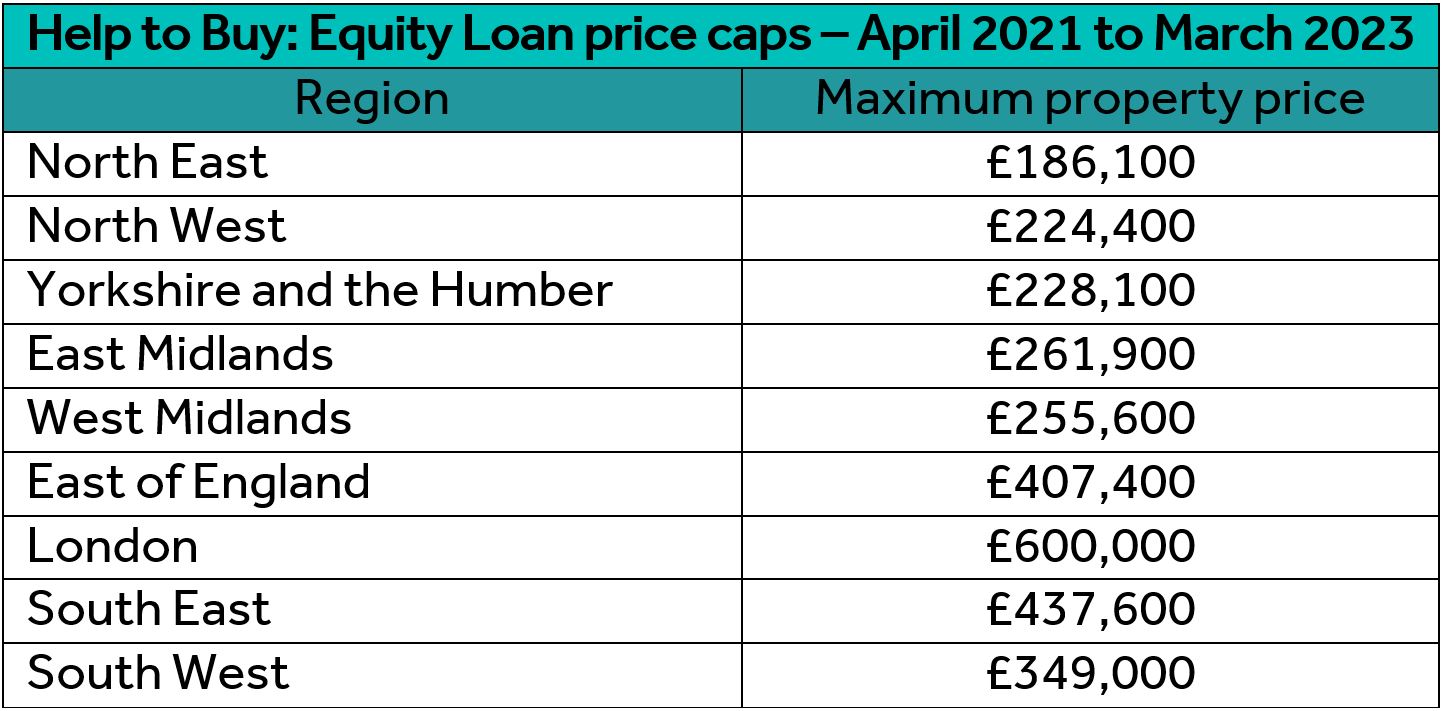
Yes, the government has introduced price caps for each region in England, so the maximum property price will depend on where you are buying.
There are the new regional price caps:
If you are considering selling or letting your property in Ashtead, Leatherhead, Fetcham, Epsom, Bookham or the surrounding areas, call V&H Homes on 01372 221 678
The asking prices of property coming on to Rightmove increased in our last two monthly reports, but this month they’ve seen a dip of around £1,500.
Is this something for sellers to worry about? We don’t think so, as there are a few reasons for the slight drop.
Firstly, the stamp duty holiday on homes up to £500,000 is due to end on 31st March, and so sellers putting their property up for sale now are perhaps pricing a bit more realistically so that they have a better chance of a quick sale.
Secondly, asking prices usually drop at this time of year, and this month’s drop is actually lower than we’ve seen over the past few years.
The good news if you’re a new seller is that buyer demand is staying strong despite the second national lockdown in England. We saw an initial, temporary dip after the new restrictions were first announced, but demand was still up by 28% on the same days last year during the three days between the announcement and the lockdown.
The first six days of lockdown saw demand jump back up to being 49% higher than this time last year, as the market is still open and agents can still operate.
The temporary stamp duty savings that can be made vary a lot depending on the price of the property you’re buying.
We had a look andfound that demand and activity compared with October last year are strongest in the price bands and regions where buyers are set to make the biggest stamp duty savings.
For example, the number of sales being agreed for properties priced between £100,000 and £200,000 is up by only 16% on this time last year.
Whereas the number of sales being agreed in the £400,000 to £500,000 price band has more than doubled (+106%).
In terms of how quickly homes are finding a buyer, the national average is now at a record low of 49 days.
However, homes priced between £400,000 and £500,000 have seen a big drop of 23 days to secure a buyer, compared to the £100,000 to £200,000 band seeing a drop of just eight days.
Regionally, the south is performing best relative to last year for the number of sales being agreed, up by 72% in the East of England, and up by 69% in the South East.
But we now estimate that there are around 650,000 sales going through, which is up by a massive 67% on the same time in 2019, and we know there are delays in the process so communication is key for people trying to get their sale over the line.
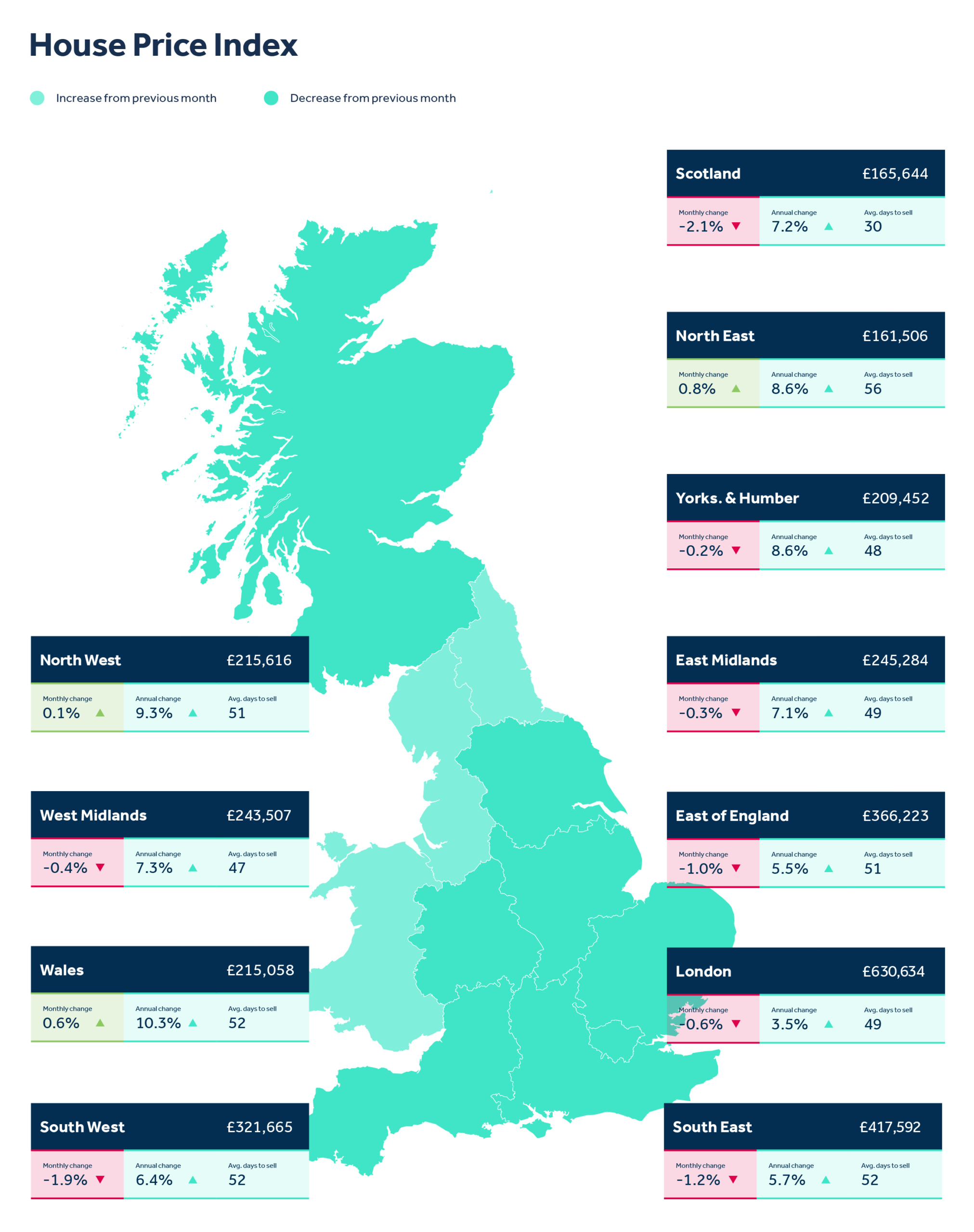
What are the headline figures?
- Average price of property coming to market dips by 0.5% (-£1,505) from last month
- The number of sellers coming to market last month was up 35% on the same time last year
- National sales agreed are up 50% on October last year, and we estimate there’s 650,000 sales going through the buying and selling process, 67% more than at the same time in 2019
- There’s been a 106% uplift in sales agreed and a drop of 23 days in time to secure a buyer in £400,000-£500,000 band
- Buyers who were temporarily uncertain in run-up to the new lockdown in England have jumped back into action, with the first six days of the second lockdown seeing demand up by 49% on this time last year, as the housing market remains open
What do the experts say?
Our resident property data expert Tim Bannister explained that sellers are much more likely to find a buyer if their first asking price is realistic, rather than setting the bar too high to begin with and having to reduce the asking price at a later date.
He said: “Given the ongoing mini-boom, prices might have been expected to rise again this month, but instead we have a slight dip which could be a result of some new sellers pricing more realistically to have a better chance of agreeing a sale in time to benefit from the stamp duty savings on their onward purchase.
“We know from a recent Rightmove study that sellers are twice as likely to sell if they agree a sale based on the first price at which their property goes on the market, something that’s even more important now as we move towards the end of March and the end of the stamp duty holiday.
“If your initial asking price is too high then you’re less likely to get an offer even after you’ve cut your price back to a more realistic level. Our revised prediction of a 7% annual increase in prices in 2020 looks to be on track, since the annual rate has jumped to 6.3% with a month to go.”
What are estate agents seeing?
Bruce King, Director of Cheffins in Saffron Walden, said: “Sellers are taking a realistic view on pricing in the current market. By competitively pricing their homes they’re looking to entice buyers and agree a deal ahead of the stamp duty deadline, whilst also being able to benefit from stamp duty savings on their onward purchase.
“Transaction levels have gone through the roof in comparison to the past couple of years due to the monumental backlog of people looking to move. Political uncertainty, Brexit and the first lockdown period caused many who were considering moving to sit on the fence, however the announcement of the stamp duty holiday was the trigger for many of these to bite the bullet and get on with moving house.
“This, coupled with the change in lifestyle which has been caused by the coronavirus outbreak, has created a pressure cooker in the market which has resulted in activity which couldn’t have been foreseen around a year ago. The market in the £400,000 – £500,000 bracket is certainly the most busy, mainly made up of second-steppers and upsizers.
“First-time buyers are continuing to struggle, as the level of deposit needed has increased and this, combined with a lack of job security for many, has meant that mortgage agreements have been harder to come by as banks change their lending criteria. Demand has remained strong in lockdown 2.0. Mid-November usually brings with it the pre-Christmas slowdown in the market; however, this doesn’t appear to be the case this year as buyers still look to get a sale over the line before the stamp duty deadline.”
Andy Shepherd, CEO of Dexters, added: “London remains a huge draw for investment and city living, and we currently have over 100,000 people registered looking for a new home or investment property, up 25% compared with this time last year.
“The recent reductions in stamp duty have coincided with a busy property market and they are motivational to buyers. However a stamp duty holiday isn’t the main reason for people buying property in the capital.
“Sellers and buyers will most likely share the extra tax burden when it returns next year and although the amounts are not insignificant, we don’t expect them to impact on the market greatly in 2021, arriving as they will in the spring which is the start of the busiest time of the year for moving home. Additionally the potential roll out of a vaccine in the new year could see a greater number of overseas buyers, increasing demand in prime central London especially.”
If you are considering selling or letting your property in Ashtead, Leatherhead, Fetcham, Epsom, Bookham or the surrounding areas, call V&H Homes on 01372 221 678

Newly released data from Halifax has revealed that during October, average house prices across the UK topped £250k for the first time ever following the strongest growth in over four years.
Halifax data shows that on a monthly basis, house prices in October saw a 0.3% rise against September and between August and October, saw a 4.0% rise against the preceding three months. Driven by the mini-boom, research shows that house prices in October were 7.5% higher than in the same month a year earlier – the strongest growth since June 2016.
Russell Galley, Managing Director, Halifax, comments: “The average UK house price now tops a quarter of a million pounds (£250,547) for the first time in history, as annual house price inflation rose to 7.5% in October, its highest rate since mid-2016. Underlying the pace of recent price growth in the market is the 5.3% gain over the past four months, the strongest since 2006. However, month-on-month price growth slowed considerably, down to just 0.3% compared to 1.5% in September.
“Overall we saw a broad continuation of recent trends with the market still predominantly being driven by home-mover demand for larger houses. Since March flat prices are up by 2.0% compared to a 6.0% increase for a typical detached property. In cash terms that equates to a £2,883 increase for flats compared to a £27,371 rise for detached houses.
“This level of price inflation is underpinned by unusually high levels of demand, with latest industry figures showing home-buyer mortgage approvals at their highest level since 2007, as transaction levels continue to be supercharged by pent-up demand as a result of the spring/summer lockdown, as well as the Chancellor’s waiver on stamp duty for properties up to £500,000.
“While Government support measures have undoubtedly helped to delay the expected downturn in the housing market, they will not continue indefinitely and, as we move through autumn and into winter, the macroeconomic landscape in the UK remains highly uncertain. Though the renewed lockdown is set to be less restrictive than earlier this year, it bears out that the country’s struggle with COVID-19 is far from over. With a number of clear headwinds facing the housing market, we expect to see greater downward pressure on house prices as we move into 2021.”
Anna Clare Harper, CEO of asset manager SPI Capital and author of Strategic Property Investing, says: “According to Halifax, house prices were 7.5% higher than in the same month a year earlier. On the face of it, this feels like positive news amidst much that is negative – economically, politically, and socially – at least for property owners. It’s not as simple as this, and this pace of growth is not forecast to continue at the same level.
“Right now, prices are being buoyed up by the temporary Stamp Duty reduction, the release of pent-up demand and supply, and the desire to improve surroundings following lockdown. For example, growth in detached properties was 6%, due to many families understandably seeking more space. Another important factor is that in times of uncertainty, there is a ‘flight to safety’: many people prefer to invest in tangible assets like property.
“The truth is, the housing market is not one market. If you’re thinking about buying a property in this fast-changing environment, one of the best things you can do is to detach from the emotional dimension, so that you are able to analyse whether you are getting a good price and ‘value for money’.”
If you are considering selling or letting your property in Ashtead, Leatherhead, Fetcham, Epsom, Bookham or the surrounding areas, call V&H Homes on 01372 221 678
“Amidst the chaos and uncertainty, the property market is a positive beacon and a sign that people are finding ways to get on with their lives.”
Lockdown part 2 will not include a second lockdown of the UK housing market.
Within hours of the announcement by the Prime Minister, Secretary of State for Housing Communities and Local Government; Robert Jenrick confirmed that renters and homeowners will be able to move; removal firms and estate agents can operate; construction sites can and should continue; and tradespeople will be able to enter homes.
RICS also confirmed that, where appropriate, professional surveying services can continue, in a safe and secure manner, and that all activities must be done in accordance with existing government guidelines. In short, it’s business as usual!
When the property market reopened in May after the first lockdown, RICS provided detailed guidance for surveyors carrying out property inspections. I was involved in helping to draft the guidance, which was based on practical first-hand knowledge of what would be required. The full details are available here: https://www.rics.org/…/covid-19-guide—rics-physical-inspe…, but the main points require surveyors to wear appropriate PPE, maintain distance from any occupiers of the property, aim for minimal amount of contact with surfaces and sanitize equipment. In the heightened atmosphere of a second lockdown, there will clearly be greater emphasis on surveyors exercising caution, but the detail of this guidance remains.
Today’s business as usual is, of course, very different to standard trading environments we have known in the past. The property market has been turbo-charged since the easing of the first lockdown and announcement of the stamp duty holiday and it has exhibited some very particular trends.
The second lockdown is likely to entrench those trends of people looking for houses with more space, both inside and outdoors, and will most probably encourage even more people to move out of large cities and suburban areas. I recently spoke to someone from a removal firm who said they are used to providing 160 quotes a month. At the moment they are averaging more than 300 quotes a month and most of these were for people leaving London and heading to the sea and countryside.
It will be interesting to see what stance the government takes regarding the end of the stamp duty holiday for properties valued up to £500,000, which is scheduled for the end of March. There are already delays in the system, leading to speculation that many current transactions may not complete in time to beat the deadline, and the property industry has called upon the government to take action to avoid a cliff edge. This second lockdown adds weight to those calls. It may well slow activity in the market, which could help to clear the backlog being experienced across the chain from mortgage lenders through to surveyors, conveyancers and local councils carrying out searches, but will also provide added considerations and potentially more delays.
It’s business as usual as it can be at the moment. People continue to be driven to move home, motivated by personal and lifestyle reasons and there is still no sign of this activity softening. Amidst the chaos and uncertainty, the property market is a positive beacon and a sign that people are finding ways to get on with their lives.
If you are considering selling or letting your property in Ashtead, Leatherhead, Fetcham, Epsom, Bookham or the surrounding areas, call V&H Homes on 01372 221 678
The housing market is to remain open during the second lockdown in England.
Uncertainty over whether estate and letting agencies will be classified as essential services under Thursday’s lockdown rules, has been clarified.
In a statement to the industry, the Government says: “Buying, selling and renting a home can continue, in a COVID-secure way, as it has in recent months. Estate and letting agents can operate, show homes and sales suites can remain open and property viewings, mortgage valuations and surveys can take place.”
Subject to approval, the regulations specifically state that activities relating to the sector are allowed to continue under exceptions to leaving home to undertake any of the following activities in connection with the purchase, sale, letting or rental of a residential property:
- visiting estate or letting agents, developer sales offices or show homes;
- viewing residential properties to look for a property to buy or to rent;
- preparing a residential property to move in;
moving house; - visiting a residential property to undertake any activities required for the rental or
- sale of that property.
V&H Homes have been operating under the Covid-19 Secure Guidelines since May and will continue to prioritise the saftey of our clients and staff whilst we remain fully operational.
We cover property sales and property lettings in Ashtead, Leatherhead, Fetcham, Epsom, Bookham and the surrounding areas.
If you are looking to sell, let, buy or rent a property, or if you are just looking for some advice, please call us on 01372 221 678.

If you’re the sort of person who enjoys watching shows like Homes Under the Hammer and thinks “I could do that!” then you’ve probably considered becoming a landlord at some stage.
But being a landlord is a tough business, and despite what some people may think, it’s not a licence to print money.
So, Rightmove have spoken to The Secret Landlord – who’s been letting, refurbishing and selling properties across the UK for almost two decades – for her top tips on what it really takes to succeed as a landlord.
An award winning landlord, as judged by the National Landlords Association, The Secret Landlord has provided accommodation for hundreds of tenants from all walks of life.
Scroll down to read their Q&A for some expert insight and hopefully you’ll learn plenty of top tips along the way!
RM: How important is budgeting as a landlord?
SL: It’s easy to get caught up and think little odds and ends don’t matter too much, but they do. Every penny of expense should be recorded and submitted. Accurate records need to be kept at all times. This will also make your life easier when they do make tax digital.
Too many investors worry about the big ticket items and don’t spend enough time thinking about the smaller spends. Money leaks out of businesses in weird and wonderful ways and you need to do your best to understand where it does to be sure you’re running an effective operation.
RM: How do you approach rent increases?
SL: Rent increases are controversial, especially when they involve long term good tenants. Rewarding tenants with no rent increases is one strategy, however another approach is to look at biennial incremental rent increases (market factors permitting). Small rises are an opportunity for you to remind good tenants they are being rewarded with a lower than market rate and allow you to build an ‘improvement pot’ to ensure your property remains in good condition.
It’s also important to understand the value of your business as a landlord where, unlike a homeowner, you will be a repeat customer for many trades and suppliers. This means you should seek out the best prices and service levels to provide the most you can for your tenants.
RM: How do you deal with things going wrong?
SL: No matter how much you try and future-proof and fool-proof a property it will always go wrong. Entropy is a fact of life. As an investor you must understand things will always decline, a roof will never fix itself and a problem will never go away until you solve it.
Solving problems always costs money and takes time and those things need to be factored in. Things will always take longer and cost more than what you initially expect, so it’s best practice to add another 10-20% to any estimate. If it comes in at price, you’ll be pleased with the ‘saving’.
RM: Is there much paperwork involved?
SL: Paperwork is a pain, but it’s also critical to ensuring you run a safe and reputable business. Records need to be kept of all ASTs, deposit certificates, gas and electrical work and ensure you diarise when things become due. Gas safety checks are annual, electrical checks are every five years, EPCs every ten years.
There are many free and low priced technical solutions available for making the headache of paperwork less stressful, which should be explored and used. Having adequate insurance is crucial, it’s best practice to also include legal expenses. Insurance is only as good as the policy small print, so it’s best to ensure you have a comprehensive one that fits your needs, not just the cheapest.
Be on top of when any guarantees, warranties and mortgage deals expire and shop around at least one month beforehand. Being prepared is key to getting the best deal.
RM: What’re your top pieces of advice for aspiring landlords?
SL: To make it as a landlord you need to be prepared for anything and everything to happen at a moment’s notice. It’s important to educate yourself and keep up-to-date with changing legislation. Landlord organisations are only a few pounds per month and offer excellent guidance along with helplines. There are also many resources available from property blogs to property forums and books. Building up a sinking fund is crucial and it’s advisable to save at least 15% of your rent for rainy days.
Like any business, buy to let has seasonal variances. Winter is worse for roof repairs, autumn for boiler problems and spring for windows and fencing. Adjust your budget so you can be ready for the year ahead. If you’re concerned by expensive boiler repairs, consider taking out a policy which protects the boiler in the event of an emergency.
Unfortunately, you cannot stop problems occurring, but the best course of action is to be prepared for when they do. If you’re going on holiday, or live far away from a property, it might be useful to take out an emergency policy to ensure repairs can be dealt with swiftly.
It’s not easy to always expect the unexpected, but planning ahead, keeping accurate records, having a good network of people and an emergency budget will help you sail through many storms.
If you are considering selling or letting your property in Ashtead, Leatherhead, Fetcham, Epsom, Bookham or the surrounding areas, call V&H Homes on 01372 221 678

Owning a leasehold property is extremely common in England and Wales, but it can be tricky to know exactly what it means.
Here, we’ve compiled a list of frequently asked questions on the subject so that you’re better equipped the next time you think about buying a leasehold.
I’ve found my dream home, but it’s a leasehold. What does that mean?
Leasehold is one of the most common ways of owning a flat/maisonette/apartment in England and Wales. The other option is freehold but, unlike freehold (where you own the property outright), leasehold only gives you exclusive ownership of the right to occupy the property for the length of the lease. This can be anything between 99 to 999 years when a lease is first created.
I’ve heard people mentioning ‘ground rent’, but will I have to pay it?
Unfortunately, there’s no way around this. Ground rent is what a leaseholder pays each year to their landlord. It can be a small amount (£10), or substantial (£200) per year. In some cases, the ground rent can increase considerably over short periods. Your solicitor should advise you if this is the case, but it’s a good idea to ask early on how much the ground rent is, whether it changes (and when) as well as the consequences of any increase.
Do ‘service charges’ apply to me if I buy a leasehold flat?
Again, you’ll need to set aside some cash for this. Service charges are your share of the cost of maintaining the building your flat/maisonette/apartment is in. It also covers the communal areas and the communal services. These charges are usually paid annually and in advance, but the amount will vary depending on the building, its age and condition. It’s important to ask your landlord about the cost of previous service charges and whether there are plans for large expenditure in the future, such as roof renewal or external painting.
I’m buying a flat in a large block on a development with communal heating and lifts, will this be expensive to maintain ?
It is difficult to know precisely what the cost of maintaining or renewing items like these will be. That is why it is always wise to establish early whether the property has a ‘reserve’ or ‘sinking’ fund. These terms are often used interchangeably, but the aim of such funds is that leaseholders contribute each year so that large expenditure for these works can be spread over a number of years, rather than a leaseholder facing a large service charge in the year the works have to be carried out.
I’m thinking of buying a leasehold flat, but how is the block maintained?
When you buy leasehold, you become a leaseholder, and, like any tenancy agreement, the lease sets out your rights and obligations. The landlord, usually a freeholder, will also have their rights and obligations set out in the lease.
Like any building, the block containing the flats will need internal and external maintenance. It may also have communal heating, or lifts that require maintenance. The freeholder is normally responsible for such maintenance, although the cost is passed on to leaseholders via the service charge. The freeholder will typically employ managing agents to manage the building on their behalf.
I understand that the building containing the flat I want to buy is managed by a professional agent, what could I do if I was unhappy about their handling of a complaint?
Building management can be complicated, so many freeholders will appoint an agent to do the day-to-day management tasks, like building insurance, organising regular and irregular repair and maintenance; and responding to enquiries from purchasers.
An agent managing a building containing flats should be registered with either the Property Ombudsman or the Property Redress Scheme. The law requires agents to join one of these redress providers in order that leaseholders dealing with property managers will be able to complain to an independent body about the service they have received.
I’m thinking of buying a leasehold flat in a retirement development, will I have to pay for any extras?
Potentially. There may be services and facilities, such as a warden (either live-in or visiting), and a 24-hour emergency call system. These may well be paid for by leaseholders through their service charges.
I have been told to look out for ‘event fees’ if I’m looking to buy a leasehold flat in a retirement development. What are these?
Event fees are common in retirement flat leases. They are payments that the leaseholder makes to the freeholder when the flat is sold on, or if it’s sub-let. The percentage is usually based on the sale price or the rent when sub-let.
In some cases, the fee is put into a fund for the continued running of the building or development to avoid large increases in service charges as time goes by. Such increases are worrying because pension income may not keep pace with them. In other instances, the payment is simply income to the freeholder and does not go towards any services. So, it’s important that at an early stage your solicitor asks whoever is managing the building(a) whether there are event fees (b) when they will arise and (c) what the payments will be based on.
How do I check on fire risks in a building where I would like to buy leasehold flat?
By reading the building’s fire risk assessment – your solicitor should ask for a copy from whoever is managing the building. All blocks of flats in England and Wales are required to have a, regular, fire safety risk assessment. It covers:
- how likely a fire is to start;
- what would happen if a fire started; and
- how to minimise the risk of fire starting or spreading
I would like to alter a leasehold flat after I buy it, but will I be able to?
Some leases ban alterations altogether, some allow it so long as you obtain consent, while others have no restrictions. Before buying you should check if you need the lessor’s consent ahead of making alterations. However, you may need to first approach the managing agent working on behalf of the lessor/landlord.
I hope to be able to sub-let a leasehold flat I’d like to buy, but will I be able to?
Some leases don’t allow any sub-letting, some require consent and others are silent (there are no restrictions on sub-letting) But because leases can vary, it’s important that you check with the lessor (your landlord, typically the freeholder), before buying, whether your flat has restrictions or conditions for sub-letting.
Can my leasehold expire?
Yes, like any tenancy, leasehold has a start and finish. Make sure you know how long is left before you buy, because as it gets shorter, it becomes more difficult to sell. Leases often start at 99 years or more, but they will get shorter as each year passes. Ideally, make sure the leasehold has over 80 years remaining. Lenders may insist on a certain length of lease, but each may have different requirements. Most set out their requirements in UK Finance’s Mortgage Lender’s Handbook. Your estate agent should be able to give you information on how long is left on the leasehold, and your conveyancer or solicitor should tell you.
You will have a right to extend the lease of a flat after two years of ownership, but you will have to pay the freeholder for this and the cost can be substantial, depending on the length left on the lease. If your lease expires, you have certain rights if you live in the property. But if you are to continue to live there you are likely to have to pay a market rent.
Here is a list of questions that you should ask your estate agent or solicitors when buying a leasehold flat:
- How many years remain on the lease?
- What is the current ground rent?
- Does the lease provide for the ground rent to increase?
- Can I see the last three years’ service charge accounts?
- Is there a sinking fund for the building and how much money is in the fund?
- Is any significant work expected to be carried out to the building in the future which will have a big impact on the service charges?
- Does the property have a managing agent; and, if so, are they registered with a redress provider?
- Can I alter the property?
- Can I rent out the property?
- Can I run a business from the property?
- Can I keep a pet at the property?
- Is there a residents’ association ?
If you are considering selling or letting your property in Ashtead, Leatherhead, Fetcham, Epsom, Bookham or the surrounding areas, call V&H Homes on 01372 221 678

As many of us get used to life away from the office, we have found that renters as well as buyers are looking to move into bigger homes with more space to work from home.
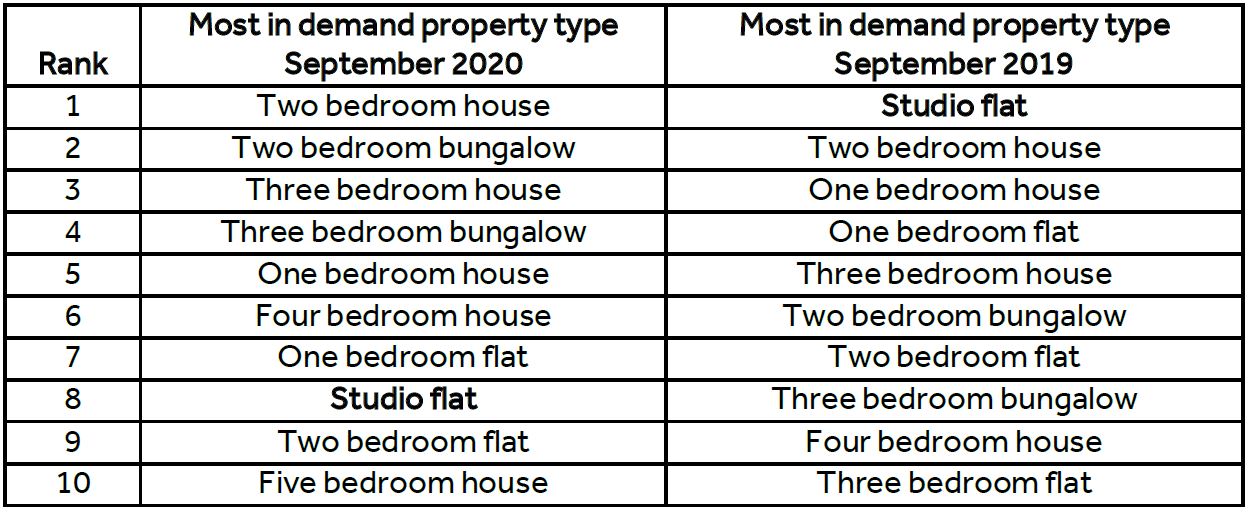
Our data analysts looked at the most popular homes among renters in September 2019 compared with September 2020, and the findings show a big change compared to this time last year.
In September 2019, the most in demand property type was a studio flat, followed by a two-bedroom house.
Last month, however, not only had two-bedroom houses overtaken studio flats as the most in demand home, studio flats had fallen seven places – behind bungalows and houses.
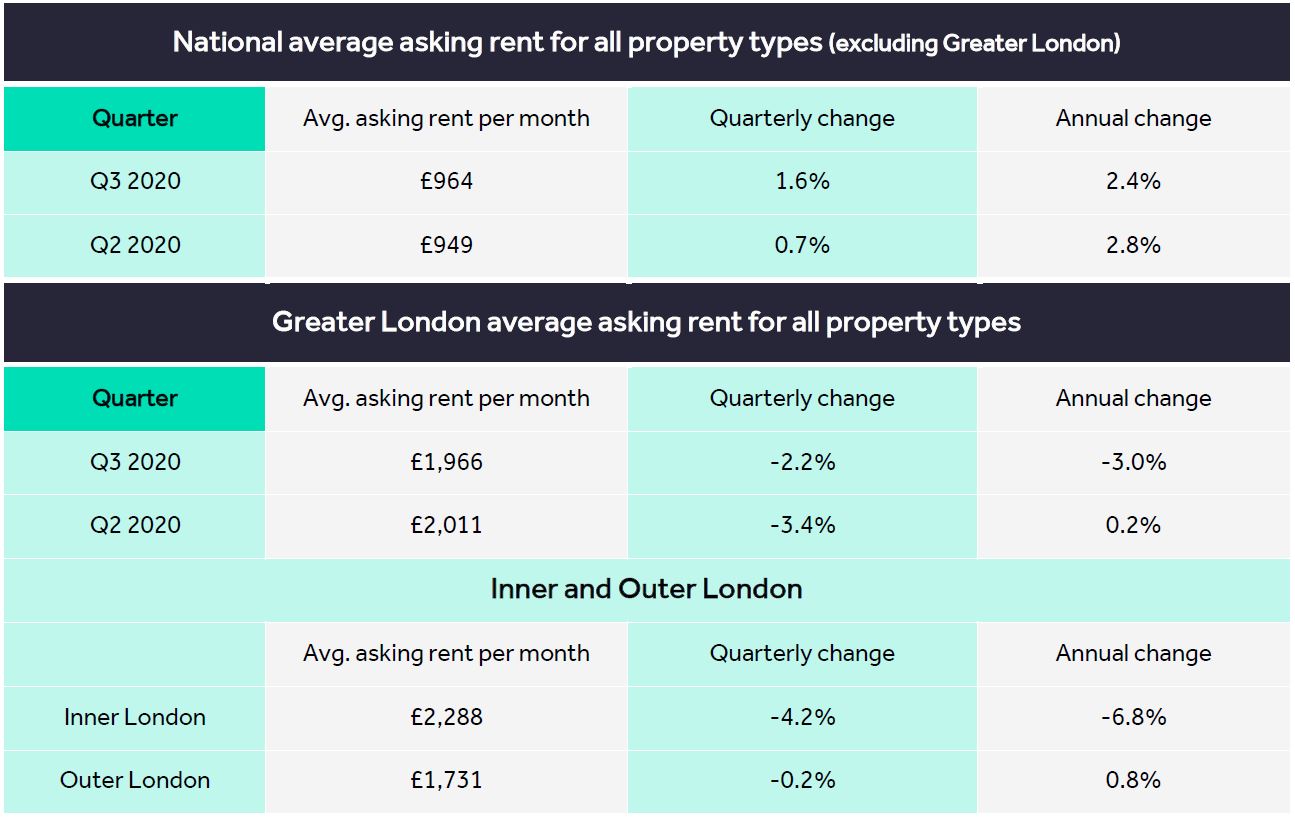
Across the rental market as a whole, asking rents have soared to an all-time high outside London to £964 per month, driven by record demand from renters.
Regionally, asking rents are up 4% in the South West and up at least 3% in the North East (+3.3%), North West (+3.1%) and Yorkshire & the Humber (+3.0%).
The number of rental homes on the market is up by 20% compared to this time last year, though because of increased competition, available stock is up by just 2% nationally, but up by 80% in London.
What’s happening in London?
London is the only region where rents are falling. They’re down 6.8% in Inner London, but in Outer London they’re up by 0.8%.
Asking rents have been falling since the beginning of lockdown in the capital, and are now an average of £110 per month lower than back on 23rd March at the start of lockdown.
Looking at property types in London, asking rents of studio flats are 3.5% lower than this time last year, one-bedroom flats are down by 3%, and two-bedroom flats are down 4%. Two-bedroom houses are faring better, up by 0.7%.
What do the experts say?
Our resident property expert Miles Shipside explained that high levels of demand for bigger rental homes, which are usually more expensive, have pushed asking rents to a record high.
He said: “Landlords with a large portfolio of studio flats may find they need to accept lower rents than over the past few years, although let’s not forget that overall rents have gone up by £100 per month outside London and £140 in the capital over the past five years so those with a longer term view will still be able to make some good returns.
“It will be the accidental landlords that have one property that need a good agent more than ever, to promote the attractive attributes of their buy-to-lets. I’ve heard from some agents that they’re now advising their landlords to turn part of the living room into a work from home space, or offering to install high-speed broadband for tenants as an added incentive.
“The rise in demand for properties that have more space and that typically have higher rents is helping push up average rents to new record highs.”
What are estate agents seeing?
Michael Cook, National Lettings MD at LRG, said: “We’ve moved more customers this September than any month previously, which is largely due to pent-up demand from tenants.
As some of the restrictions imposed during the pandemic began to lift, there was a documented surge in enquiries from renters who were restricted from moving over the spring. Changes to stamp duty also saw some investors take advantage of reduced acquisition costs of new properties and an increase in buy-to-let purchases.
However, we’re still seeing a gap in supply and demand and the need for more homes – many thousands more homes in the Private Rented Sector – is clear. At the same time, COVID has changed tenant priorities, with many now wanting bigger homes with gardens and a separate space to work in, and this now comes at a premium.
Demand for rental stock outside of London has outpaced that shown in the capital with a requirement for more home working space and gardens and a reduction in the need to be in such close proximately to the office, with more flexible homeworking being offered by employers. We’ve also seen houses increase in demand over flats with people looking to rent properties for longer, increasing average tenancy lengths.”
If you are considering selling or letting your property in Ashtead, Leatherhead, Fetcham, Epsom, Bookham or the surrounding areas, call V&H Homes on 01372 221 678
With many homeowners rushing to sell their properties and others looking to move thanks to the Stamp Duty holiday, homeowners have revealed the features they’re looking for, and the one’s they’re keen to avoid. According to new research from Hammonds Furniture, certain features could knock an average of £49,471 off your home.
Noisy neighbours, pet smells, pebble dash, being near a pub and the notorious Japanese knotweed are some of the most undesirable features of a house that would convince homeowners to ask for a discount or put them off a purchase altogether.
However, the two things most likely to put a potential homebuyer off a house were mould or damp on the walls (62%) and signs of a pest infestation (57%). Michael Patterson, Managing Director of WeBuyAnyHouse, claims these issues can knock a huge 20% off a property’s value, or £49,471 off the average house price of £247,355.
He said: “Mild cases of mould may not affect value too dramatically if all is needed is a dehumidifier and some mould-resistant paint, but very severe cases can reduce a property’s value up to 20%. Pests can also cause extensive damage, especially rats that are prone to chewing through electrics and wooden beams, which you would need to repair. Depending on the damage done, you could be looking at between 5-20% of a decrease in value”. However, while it’s common to be put off by signs of disrepair and neglect that may cost a significant amount of money to fix, surprisingly, a large number of homebuyers also claimed to be put off by features that can be quickly rectified.
A third of people (33%) would be put off a house if it had a messy garden, which could knock off up to 20% of a properties price, according to Michael. A quarter (24%) of people would look elsewhere if the house had ugly wallpaper, and two in ten (19%) people would be put off by holes in the walls from hanging pictures or paintings. A huge 37% of people would find pet smells off-putting, and 28% would reconsider a purchase if a house had a weak shower.
Many features that are out of a property owners’ control have also been proven to be detrimental to the price of a property. Four in 10 (39%) people would reconsider a purchase if a house if it had a “messy looking” neighbouring house (39%), almost half would if they could hear noisy neighbours (48%) and a surprising three in 10 people would dislike the thought of a pub nearby (32%). Perhaps less surprising, 14% would be put off buying a house if the road had a rude street name.
Other house buyers also claimed that they would be put off by features that others might find attractive; one in 10 people (10%) wouldn’t choose a property if it had a swimming pool or hot tub, and 13% would dislike laminate flooring.
When it comes to features that house buyers would pay more for, a garden tops the list with almost half of all homebuyers (45%) claiming that they would pay more for outside space. This is closely followed by a garage (37%) a conservatory (31%) and a loft conversion (27%).
Only 15% of people would pay more to be close to public transport, just 13% would pay more for a log burner and only 8% of people would be swayed by smart meters in the home.
According to Michael: “A nice sized garden can add up to 25% more on a house price, especially if it is well maintained with a seating area for the summer. A carriage driveway can add up to 15%, and an attractive conservatory can add up to 10% to a house price. If a loft conversion can be used as an extra bedroom, it can add 20% to a property price.”
Holly Herbert, Head of Content at WeBuyAnyHouse, offers her advice:
“In general, to get a house in a good position to sell I would say decoration is key – freshly painted walls make a big difference, even if it’s the same colour as before, as it will make the place brighter and remove any scuffs and marks. Gathering all information about the house for viewers is also important; general running costs, council tax band, local transport links. Getting it all in one place so you have it to hand with no hesitation is something buyers appreciate. And don’t forget to take the best possible advertising photos.”
Kirsty Oakes, Head of Product and Marketing at Hammonds Furniture, said:
“We all have something in mind when we begin a search for our next home, but there are certain features that for many people could be an absolute dealbreaker. However, some of these features are surprisingly quick and simple to amend if you are looking to sell your house.
“If you’re selling, you can make your house look much more appealing by making some small changes, such as filling in holes in the wall or switching to a neutral colour pallet. A deep clean can make a huge difference to how your property is perceived, and well as clearing away extra clutter (even if you just store it in your car). Don’t be afraid to ask your neighbours to clean their garden as well!”
If you are considering selling or letting your property in Ashtead, Leatherhead, Fetcham, Epsom, Bookham or the surrounding areas, call V&H Homes on 01372 221 678